
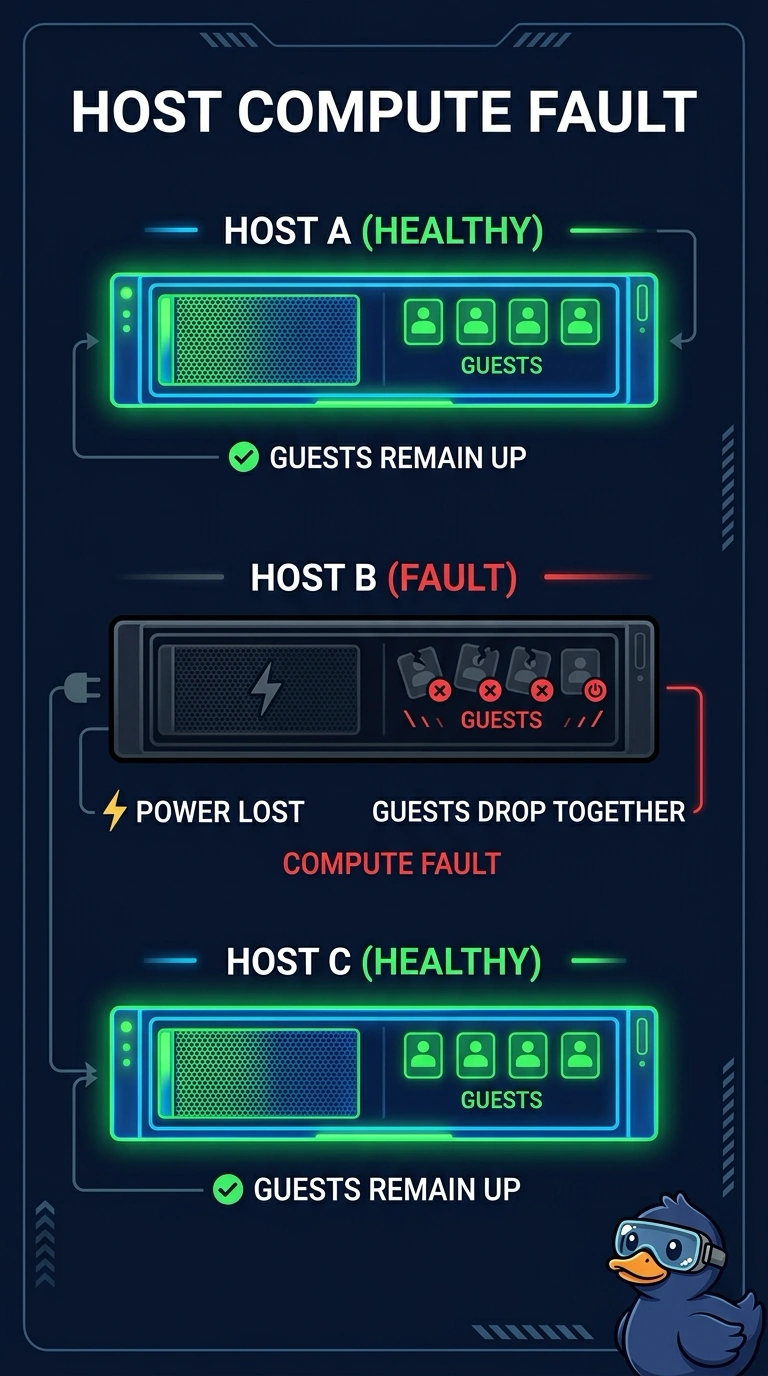
Several packet-gateway guests on one ferry compute host drop together when that host loses power. Guests on other hosts stay up, volumes stay readable, and the cloud API still accepts calls. Which fault is this?
Select an answer to reveal the explanation.
Short Explanation
One darkened kitchen in a row of restaurants is like a single compute host that lost power. You call this a compute fault because only the guests on that host failed. A VIM API fault, a storage fault, and a single guest fault do not match an API that accepts calls, volumes that read, and a whole host that died.
Full Explanation
A compute fault is the host itself. Several packet-gateway guests on one ferry host dropped together when that host lost power. Guests on other hosts stayed up, volumes stayed readable, and the cloud API still accepts calls. That pattern is the compute host, not the VIM API, not storage, and not a single guest. A guest failure on a healthy host would leave the other guests on that host running. A compute fault on the host that lost power and took the guests that were running there is the design that meets this requirement. A VIM API fault, although the cloud API still accepts calls from the operator is the wrong fit because the cloud API still accepts calls from the operator, so this outage is not a VIM API fault. A storage fault, although volumes on the surviving hosts stay readable is the wrong fit because volumes attached to the surviving hosts stay readable, so the failure is not a storage fault. A single guest fault, although every guest on that one host failed together is the wrong fit because every guest on the dead host failed together, so this is not one guest failing on a healthy host. Exam caveat: A compute fault covers the guests that shared the failed host, and one guest failing later on a healthy host would be a guest fault instead. Operational check: Confirm the powered-down host is unreachable, guests on other hosts still respond, volumes still read, and the cloud API still accepts a call.