
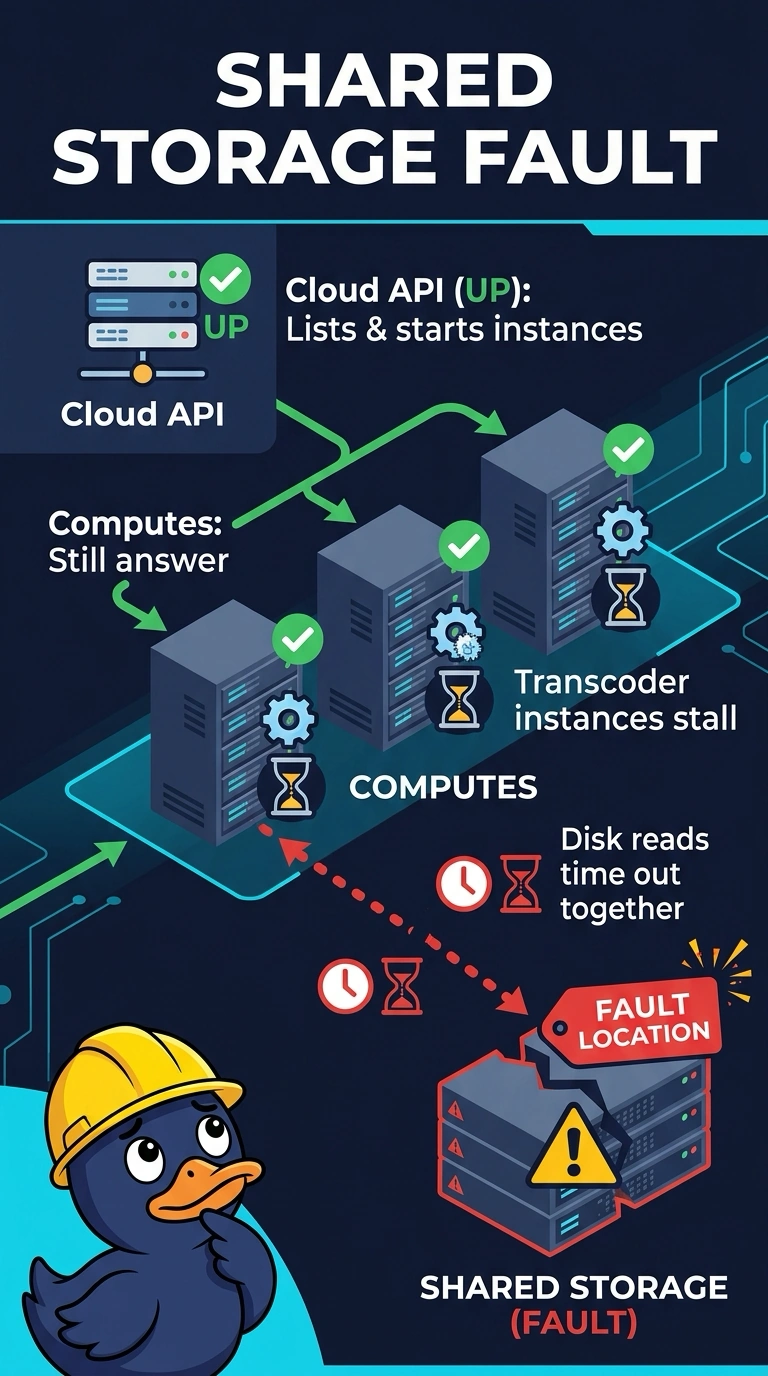
Transcoder instances on many different computes all stall on disk reads at the same moment, those computes still answer, and the cloud API can still list and start instances. Where is the fault?
Select an answer to reveal the explanation.
Short Explanation
When every kitchen stalls on the same locked pantry, you check the pantry before blaming one cook or the front desk. You treat these simultaneous disk timeouts as shared storage, because the computes still answer and the cloud API still lists instances. A dead compute host, a failed VIM API, and one guest crash would look different from a stall on every transcoder.
Full Explanation
A storage fault shows up as disk errors on guests that do not share a compute host, while those hosts and the VIM API keep answering. A compute fault takes down a host and the guests on it. A VIM API fault breaks controller calls such as list and create. One guest fault stays inside that guest. Simultaneous disk timeouts with a live API and live computes point at shared storage. A shared storage fault that leaves the computes and the cloud API up while the disks time out is the design that meets this requirement. A compute-host fault that would take down the guests and the host on one failed server is the wrong fit because the computes still answer and the stalls span many hosts, so this is not one server dying with its local guests. A cloud-controller API fault that would stop list and create calls against the VIM is the wrong fit because the API still lists and starts instances, so the controller path these operators use is not the failed component. A single guest operating-system fault inside one transcoder that the other instances do not share is the wrong fit because one guest crash would leave the other instances reading disks, and here every transcoder stalls together. Exam caveat: A guest that is down is not evidence the VIM is down, and a VIM that still serves API calls can sit in front of storage that has already failed. Operational check: Compare disk errors across computes, confirm those hosts still respond, and confirm a fresh list call to the VIM API still succeeds for a new instance.