
New instances fail because their image volume cannot be read, while compute hosts answer, the VIM API is healthy, and a running guest stays up. Which fault is that?
Select an answer to reveal the explanation.
Short Explanation
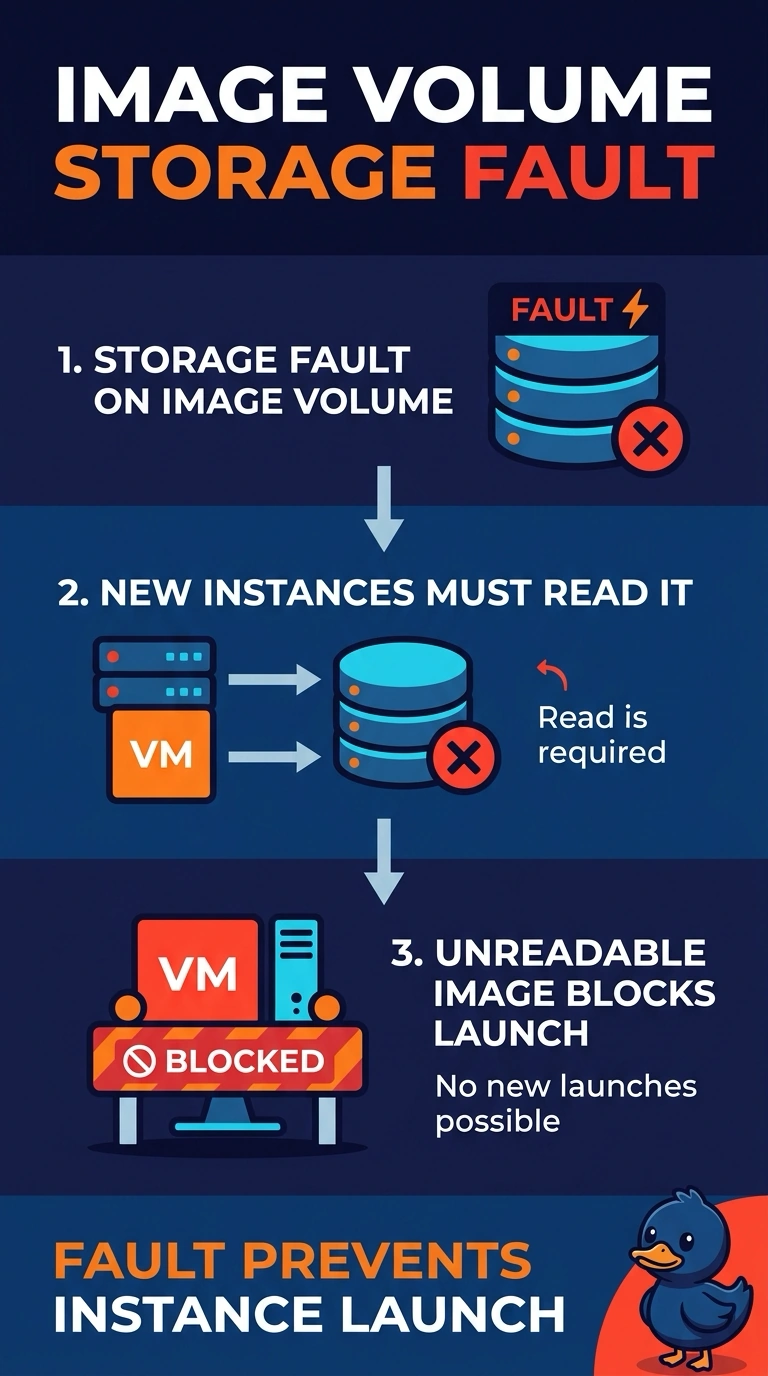
A locked closet can stop new move-ins while the front desk and current tenants are fine. You identify a storage fault because the image volume cannot be read, even though the compute hosts and VIM API still answer and a running guest stays up. The compute, VIM API, and guest faults describe layers that are still working here.
Full Explanation
NFVI faults are distinguished by the layer that has failed. A storage fault occurs when a volume the cloud needs cannot be read. Here, the image volume is unreadable, so new instances cannot launch even though the compute hosts still answer, the VIM API remains healthy, and a running guest stays up. The storage fault on the image volume is therefore the match. A compute fault on hosts still answering placement and health checks does not fit: those responses show the hosts are not the failed layer, so the launch failure is not evidence of a dead compute host. A VIM API fault on a controller interface returning healthy responses does not fit either, because the API is responding rather than stopping the launches. A guest fault in the running guest is also inconsistent: that guest stays up, and its health does not explain why new instances cannot read the image volume. Exam caveat: A failed launch does not by itself mean the VIM API or compute hosts failed; identify which required layer is actually unavailable. Practical check: Confirm that reading the image volume fails while the compute hosts still answer, the VIM API returns healthy responses, and the already running guest stays up.