
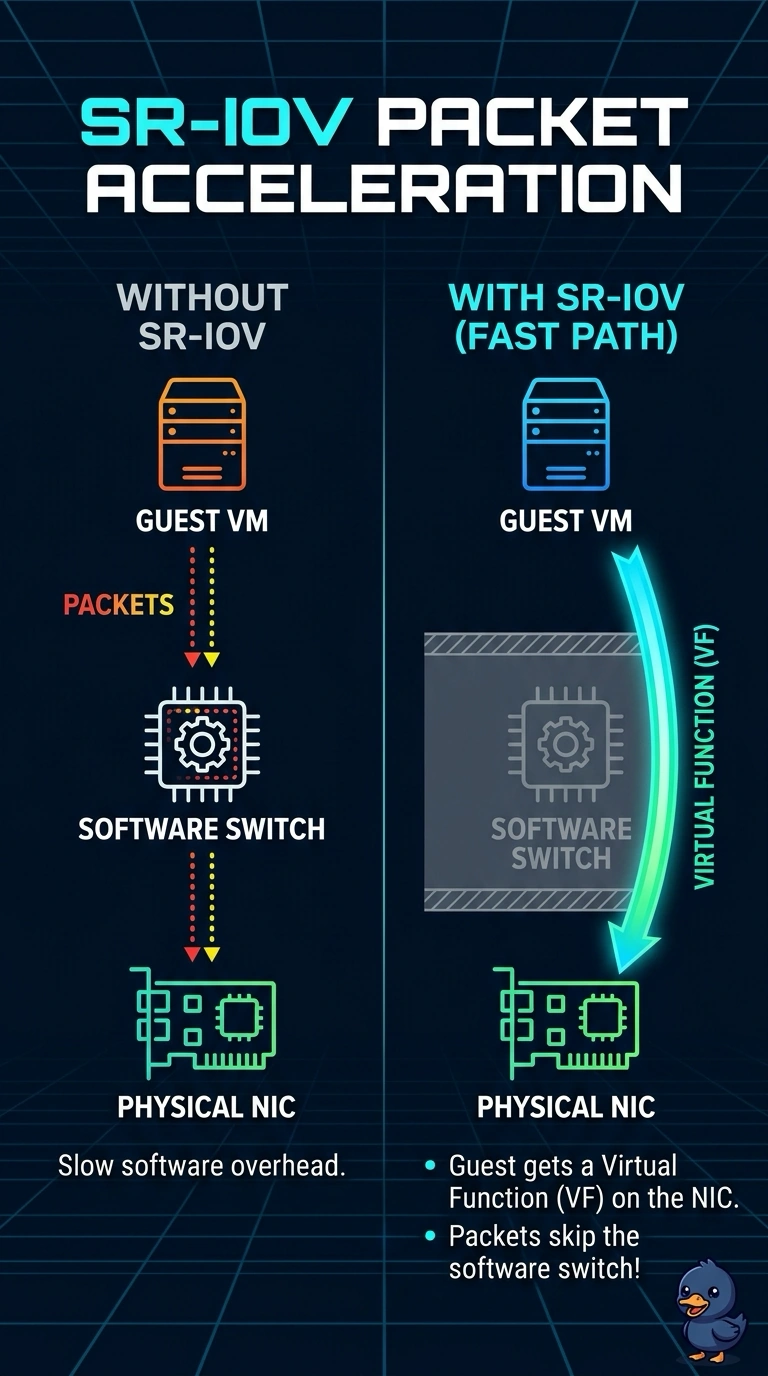
A virtual router must forward at a high packet rate, and the guest must receive frames on a virtual function of the physical NIC so the software switch is skipped. Which acceleration matches?
Select an answer to reveal the explanation.
Short Explanation
An express lane that skips the booth is different from hiring a faster clerk in the booth. You give this high-rate virtual router a virtual function so packets skip the software switch. User-space forwarding with DPDK, user-space forwarding with VPP, and a low-rate software switch path serve other goals.
Full Explanation
SR-IOV gives the guest a virtual function on the physical NIC so packets skip the software switch. That is the acceleration this high-rate virtual router is asking for. DPDK and VPP move forwarding into user space so the kernel path is not the bottleneck, which is a different way to chase packets per second. Leave the guest on the ordinary software switch when the workload is a simple low-rate guest, not when the packet rate is the problem. SR-IOV, giving the guest a virtual function on the NIC so packets skip the software switch is the design that meets this requirement. DPDK user-space forwarding that speeds a software path without handing the guest a virtual function is the wrong fit because user-space forwarding speeds a software path, and this requirement is a virtual function that skips the software switch. VPP user-space forwarding that keeps packet processing in software on the host is the wrong fit because user-space packet processing still forwards in software, rather than handing the guest a virtual function on the NIC. The ordinary kernel software switch, a fit for a low-rate guest rather than this packet rate is the wrong fit because the ordinary software switch fits a simple low-rate guest and does not give this high-rate router a virtual function. Exam caveat: Use DPDK or VPP when the job is to move forwarding into user space for packet rate. Use SR-IOV when the guest must take a virtual function and skip the software switch. Operational check: On the compute host, confirm the virtual router guest holds a virtual function on the physical NIC and that its packets do not pass through the software switch.