
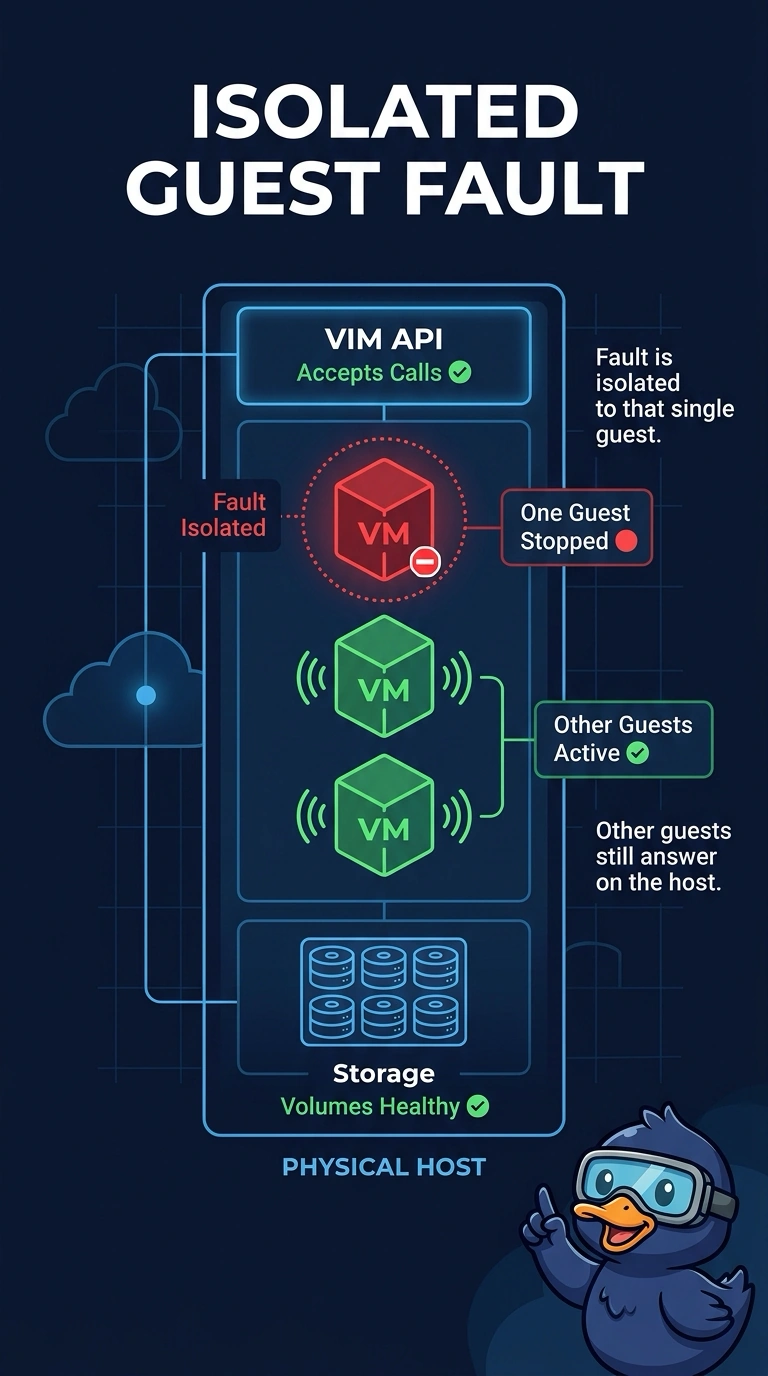
One tenant guest is stopped. Other guests on the same compute host still answer, their storage volumes are healthy, and the VIM API accepts calls. Which fault matches that evidence?
Select an answer to reveal the explanation.
Short Explanation
One dark window does not mean the whole building lost power. You treat this as a fault of that tenant guest, since the host, the storage, and the controller API still work. A compute fault, a storage fault, or a controller API fault would have shown up in those other checks.
Full Explanation
A stopped guest is not proof that the VIM is down. Here the other guests on the same host answer, so this is not a compute-host fault. Their volumes are healthy, so this is not a storage fault. The VIM API accepts calls, so this is not a controller fault. Start with the affected instance’s status, fault record, console, and its own attached volume. Other healthy instances and successful API calls rule out a broad outage but do not establish this instance’s cause. A guest fault that stays isolated to the one tenant guest that is stopped is the design that meets this requirement. A compute-host fault that would take down the other guests on that host is the wrong fit because the other guests on the same host still answer, so the compute host is not the failed part. A storage fault that would break the volumes the other guests are using is the wrong fit because the other guests are using healthy volumes, so shared storage is not the part that failed here. A VIM API fault that would make the controller reject the calls it is accepting is the wrong fit because the VIM API is still accepting calls, so the controller path is not the part that failed here. Exam caveat: A guest can be stopped because of its own image or configuration while the VIM that created it is healthy. Operational check: From the VIM, list guests on that host and confirm only one is stopped.