
A utility needs an immediate notice when a router power supply fails. Flow records and a slow counter poll are already collected. The notice must be an event from the router, not a reading from inside a guest. Which method matches?
Select an answer to reveal the explanation.
Short Explanation
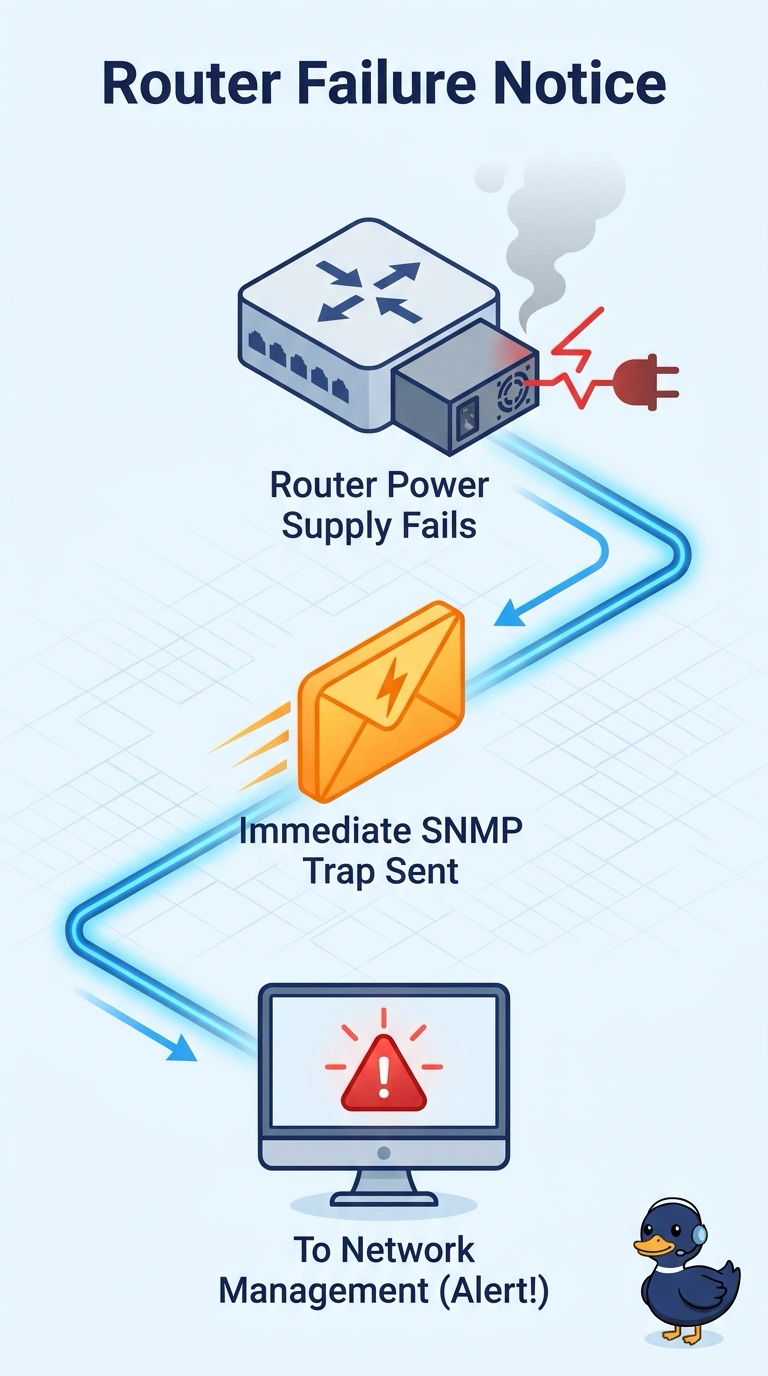
A smoke alarm calls you when it smells smoke; walking past the building once an hour does not. You need an immediate event from the router itself when a power supply fails. That is an SNMP trap, not the next poll and not a flow record.
Full Explanation
An SNMP trap is an unsolicited notification the device sends when a condition changes, which matches an immediate notice of a failed power supply from the router. A poll asks on a schedule and can see the supply only at the next cycle, so it misses the immediacy the utility asked for. IPFIX describes conversations, addresses, and volumes; a power-supply failure is not a flow. A cloud agent reports from inside a guest and, in this scenario, is explicitly the wrong place because the notice has to come from the router. Exam caveat: traps are often delivered unreliably, so a trap is the immediate signal and a later poll is how you confirm the supply is still down. Operational check: fail a redundant supply in a maintenance window and confirm the trap receiver logs the supply event before the next poll cycle. The conversation-flow records already collected do not report this router’s power-supply state. Keep the trap for the immediate event and let the existing poll confirm the supply is still down if a trap is lost.