
A game host on one customer address is hit by a UDP flood with expressible header fields, such as destination prefix, protocol, ports, or packet length. The link still has spare capacity, legitimate sessions to that host must continue, and every edge must drop only that flood. Which response matches the blast radius?
Select an answer to reveal the explanation.
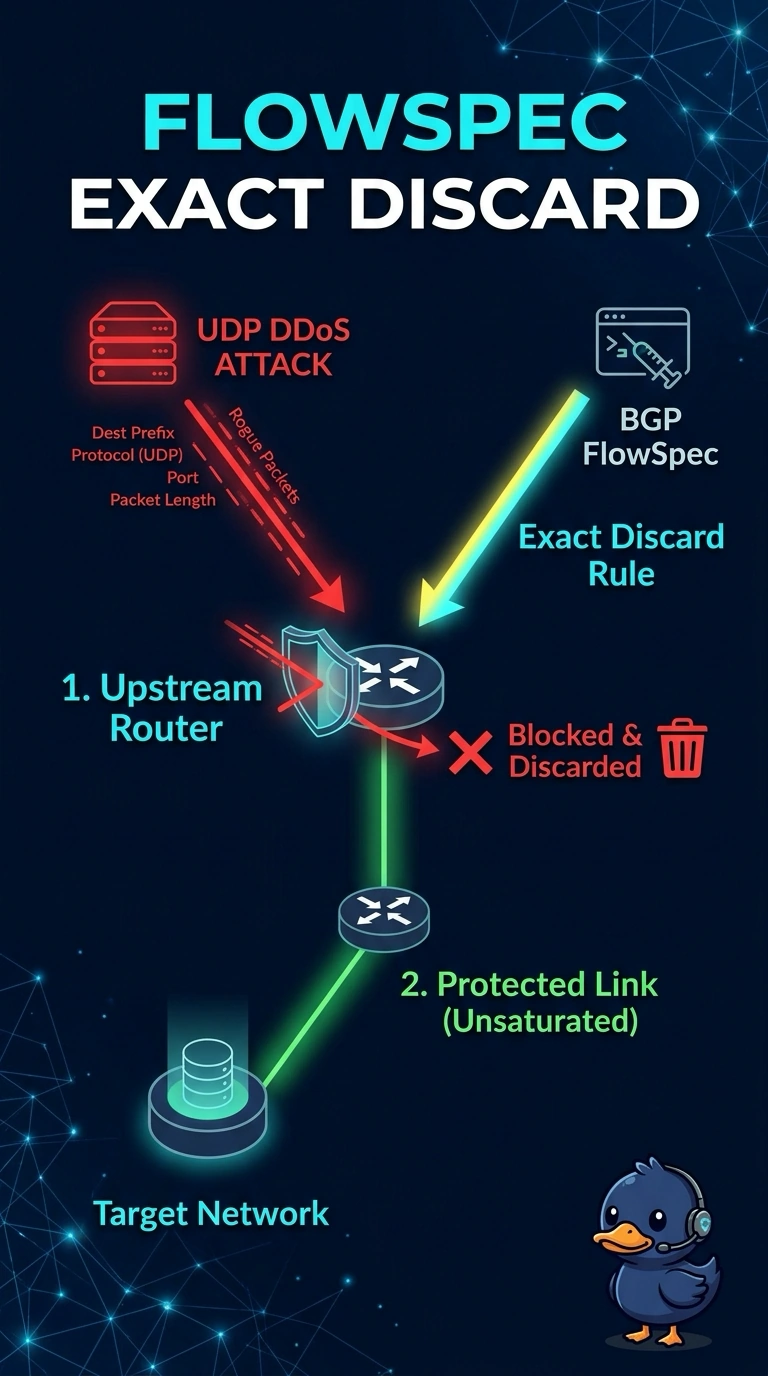
Short Explanation
You can name this flood, so you send every edge the same precise rule. Distribute a FlowSpec discard rule for the attack’s expressible header fields, such as destination prefix, protocol, ports, or packet length, and verify the rule installs upstream of any saturated link. You keep the host reachable for everyone else.
Full Explanation
Distribute a FlowSpec discard rule for the attack’s expressible header fields, such as destination prefix, protocol, ports, or packet length, and verify the rule installs upstream of any saturated link. That distributed filter matches only the UDP flood at every edge, so spare link capacity remains usable and legitimate sessions to the same host continue while the prefix stays advertised. A destination RTBH route discards matching traffic; it does not simply withdraw the prefix. A remote black hole for the entire customer prefix that contains the game host therefore still discards all traffic to that destination, including the legitimate sessions that must continue, which is wider than the required signature-only drop. A remote black hole for the provider aggregate that carries many customers discards traffic destined to many unrelated customers, so the blast radius expands from one host to an aggregate. A scrubbing diversion of the whole prefix when a distributed exact filter was required reroutes all traffic for that prefix for cleaning, which is a wider move than installing an exact distributed discard for a flow that can be described. Confirm edge counters show drops only for the described fields and legitimate sessions still complete.