
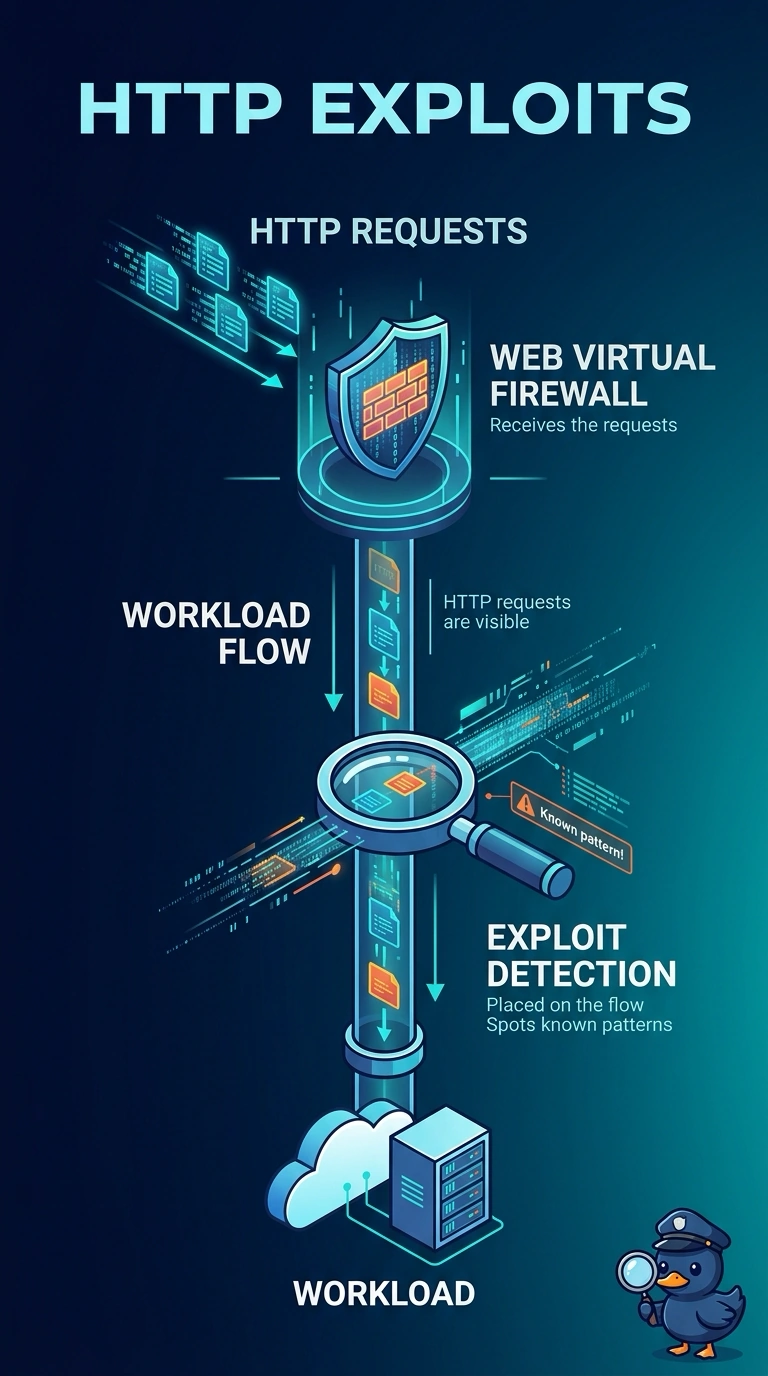
A transit customer portal is receiving a known exploit pattern inside HTTP requests to the web virtual firewall. Which service can see that attack?
Select an answer to reveal the explanation.
Short Explanation
Exploit detection is like a guard who reads the letter, not someone who only checks the return address on the envelope. You put that detection on the HTTP flow to the portal, where the known pattern is visible. DNS security, a disk malware scan, and an offline image inventory each look at queries, files, or a package instead of this request stream.
Full Explanation
Place each cloud security service where the traffic or the workload it understands can actually be seen. This incident is an exploit pattern inside HTTP requests, so exploit detection has to sit on that flow or on the workload receiving it. DNS security sees name queries, not the HTTP body. Malware detection aimed at disks, and an inventory of the image, never watch the live requests. Those tools answer different questions. Exploit detection placed on the workload flow where those HTTP requests are visible is the design that meets this requirement. A DNS security service that inspects queries at the recursive resolver is the wrong fit because DNS security sees queries at a resolver and does not inspect the HTTP exploit inside requests to the portal. Malware detection that scans guest disks at rest and does not watch the live flow is the wrong fit because a disk scan looks for malware at rest on the guest and does not watch the live HTTP flow where this exploit arrives. An offline inventory of the portal image that does not see request traffic is the wrong fit because an image inventory reviews what was packaged and never observes the requests hitting the portal. Exam caveat: Exploit detection on the flow does not scan a disk for stored malware, and a clean DNS log does not clear an HTTP exploit the resolver never saw. Operational check: Confirm the detector alerts on the known HTTP pattern at the portal flow and that the DNS logs stay a separate record of queries rather than the proof for this exploit.