
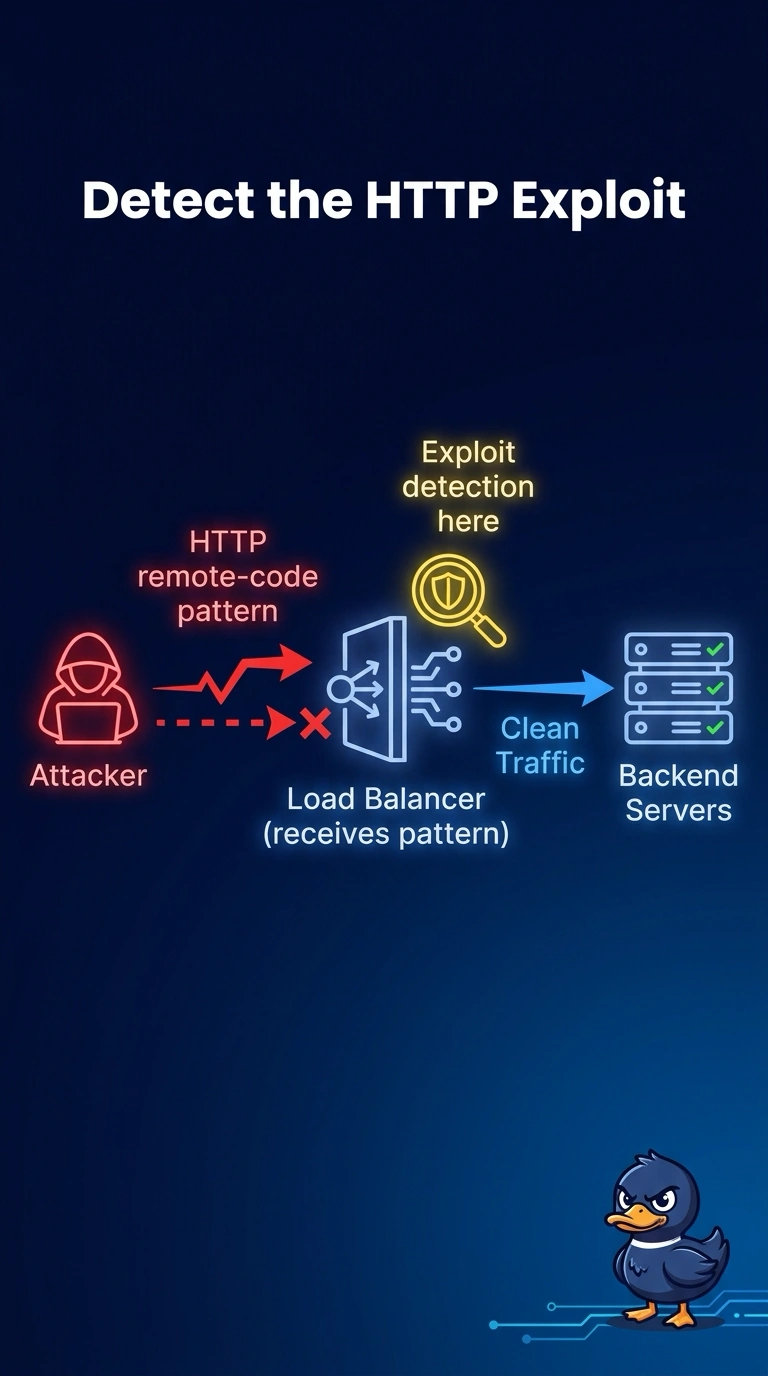
A known remote-code pattern arrives as HTTP at a transit-agency virtual load balancer. DNS queries look ordinary, and disk scans of an image library never see this live flow. Where should detection sit?
Select an answer to reveal the explanation.
Short Explanation
A guard belongs at the door that is being forced, not in the mailroom and not in the archive. You place exploit detection on the load-balancer HTTP flow, because that is where the remote-code pattern arrives. DNS security, a disk malware scan, and an exploit detector on the resolver do not see those HTTP attempts.
Full Explanation
Exploit detection has to sit on the workload or the flow where the exploit arrives. This pattern is HTTP into the load balancer, so that is the place to watch. DNS security sees DNS queries, which are ordinary here. Malware detection on a disk sees files at rest in the image library, not this live request. The same exploit detector on a resolver that never forwards the HTTP still cannot see the attack. Exploit detection on the load-balancer flow that actually receives the HTTP remote-code pattern is the design that meets this requirement. A DNS security service on the resolvers, watching queries that do not carry this HTTP pattern is the wrong fit because DNS security sees queries, and these queries are ordinary and do not contain the HTTP remote-code pattern. Malware detection that scans image-library disks and does not see this live HTTP flow is the wrong fit because malware scanning of stored images inspects files at rest and never observes the live HTTP flow on the balancer. Exploit detection installed only on a recursive resolver that does not forward the HTTP attempts is the wrong fit because an exploit detector on a resolver still misses the attack when that resolver does not see the HTTP attempts. Exam caveat: DNS security is the right service when the suspicious traffic is the query itself, and a disk scanner is right when the payload is a file at rest. Operational check: Send a test HTTP pattern only to the load balancer and confirm the exploit detector alerts while the DNS logs and the image-library scan stay quiet.