
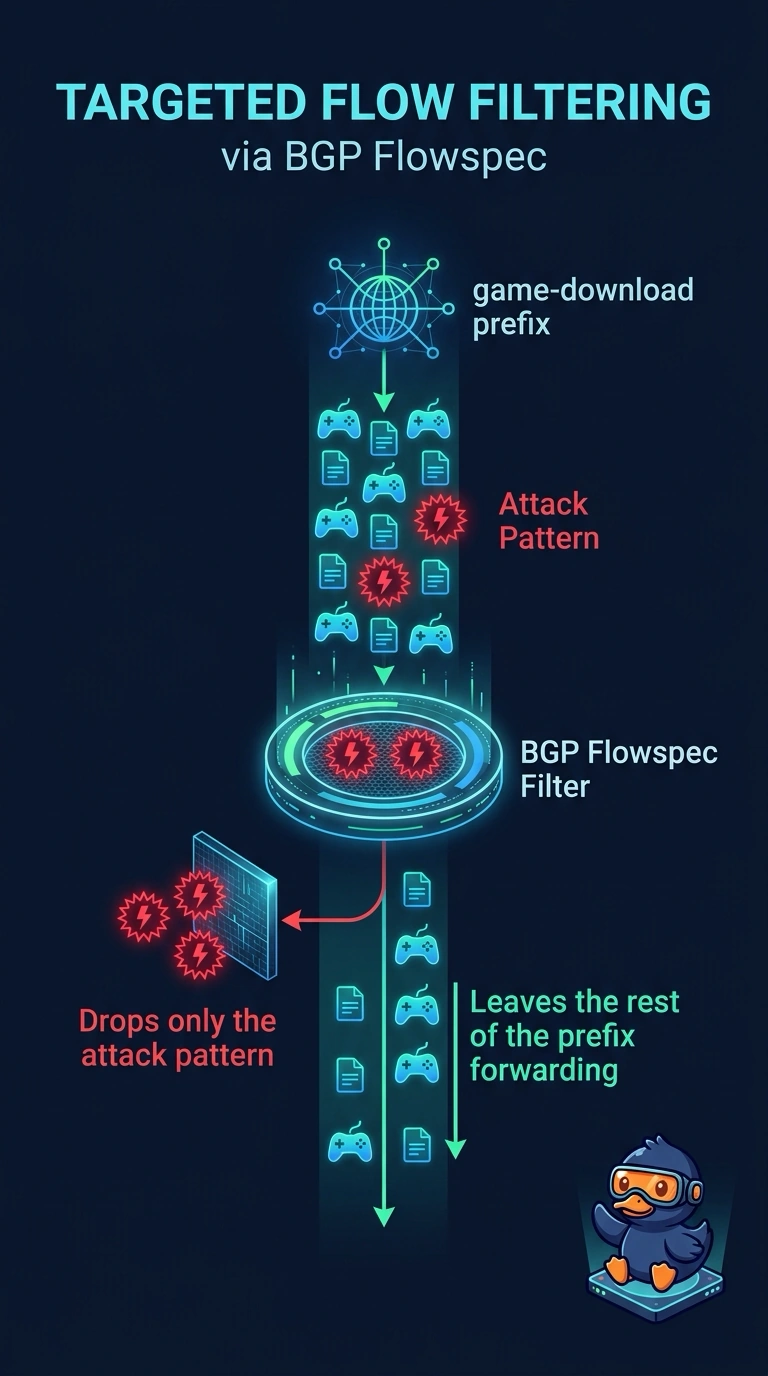
Edge routers can already drop one attack pattern aimed at a game-download prefix, and every other packet to that prefix must stay on the current path. Which mitigation fits that blast radius?
Select an answer to reveal the explanation.
Short Explanation
A strainer that catches one kind of debris leaves the rest of the stream running, and damming the river does not. Distribute a FlowSpec discard rule for the attack’s expressible header fields, such as destination prefix, protocol, ports, or packet length, and verify the rule installs upstream of any saturated link. You keep the rest of the download prefix up while wider black-holing or off-path scrubbing takes down far more.
Full Explanation
Distribute a FlowSpec discard rule for the attack’s expressible header fields, such as destination prefix, protocol, ports, or packet length, and verify the rule installs upstream of any saturated link, leaving the rest of the prefix on its current path. A destination RTBH route discards matching traffic; it does not simply withdraw the prefix, so using it for the whole game-download prefix still completes the outage for that customer. Scrubbing cleans traffic only after diverting the whole prefix off-path. Black-holing the provider aggregate creates a much larger blast radius. A BGP flowspec filter that drops only the attack pattern and leaves the rest of the prefix forwarding is the design that meets this requirement. A remote triggered black hole for the entire game-download prefix under attack is the wrong fit because discarding the whole prefix removes healthy traffic with the attack. A diversion of that whole prefix to a scrubbing center off the current forwarding path is the wrong fit because it moves the entire prefix off-path when the edge can already drop only the attack pattern in place. A black hole for the provider aggregate that also drops every other customer on the router is the wrong fit because it punishes every other customer and does not target this one flow. Exam caveat: Scrubbing fits when the edge cannot drop the flood. Operational check: Confirm other packets keep the original path.