
A transit provider's automation script creates networks by calling the VIM API, and both the script and the API must prove their identities before any call is accepted. Which control matches that requirement?
Select an answer to reveal the explanation.
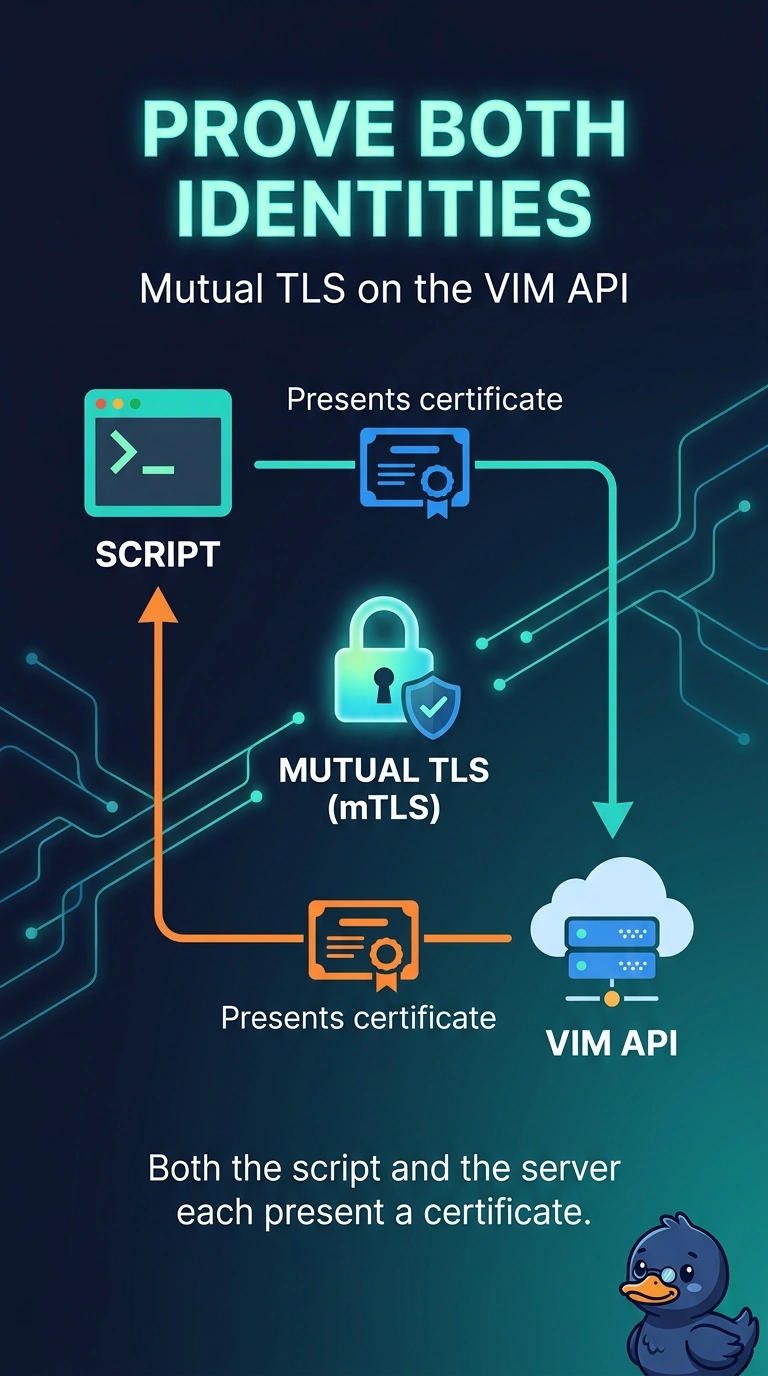
Short Explanation
Mutual TLS is like a loading dock where both the driver and the warehouse show badges before the door opens. You need the script and the VIM API to prove each other, so both certificates belong on that call. Server-only TLS, a tenant access list, and TACACS each check a different party or a different plane.
Full Explanation
Mutual TLS authenticates both ends of the API channel. The transit script is a client of the VIM, so the server must prove it is the real API and the script must prove it is an allowed caller before a network is created. One-sided TLS leaves the caller unchecked. A tenant access list and a device-login system sit on different planes and never identify that API client. Mutual TLS on the VIM API so the script and the server each present a certificate is the design that meets this requirement. TLS that authenticates only the API server and skips the calling script is the wrong fit because server-only TLS proves the API endpoint you reached, but it never proves which script is calling that endpoint. An access list on tenant packets that misses the orchestrator API call is the wrong fit because a packet filter on tenant traffic does not authenticate either side of an orchestrator call to the VIM API. TACACS logins for engineers administering routers, with no API identity check is the wrong fit because TACACS checks people logging into network devices and does not prove an automation client to the VIM API. Exam caveat: Mutual TLS identifies the API client and the server, but it does not replace tenant segmentation or keep the cloud control plane off guest workloads by itself. Operational check: Reject a client with no certificate or an untrusted certificate. If certificate revocation is configured and enforced, also verify rejection of a revoked client certificate.