
A large hospital system hosts its patient portal on a single public prefix. During a volumetric DDoS, edge links fill with traffic toward that portal prefix and the core is at risk. The hospital accepts loss of all traffic to the victim prefix. Operators require a BGP-triggered destination discard across participating provider edges. Which control drops the attack traffic toward a victim prefix at the provider edge?
Select an answer to reveal the explanation.
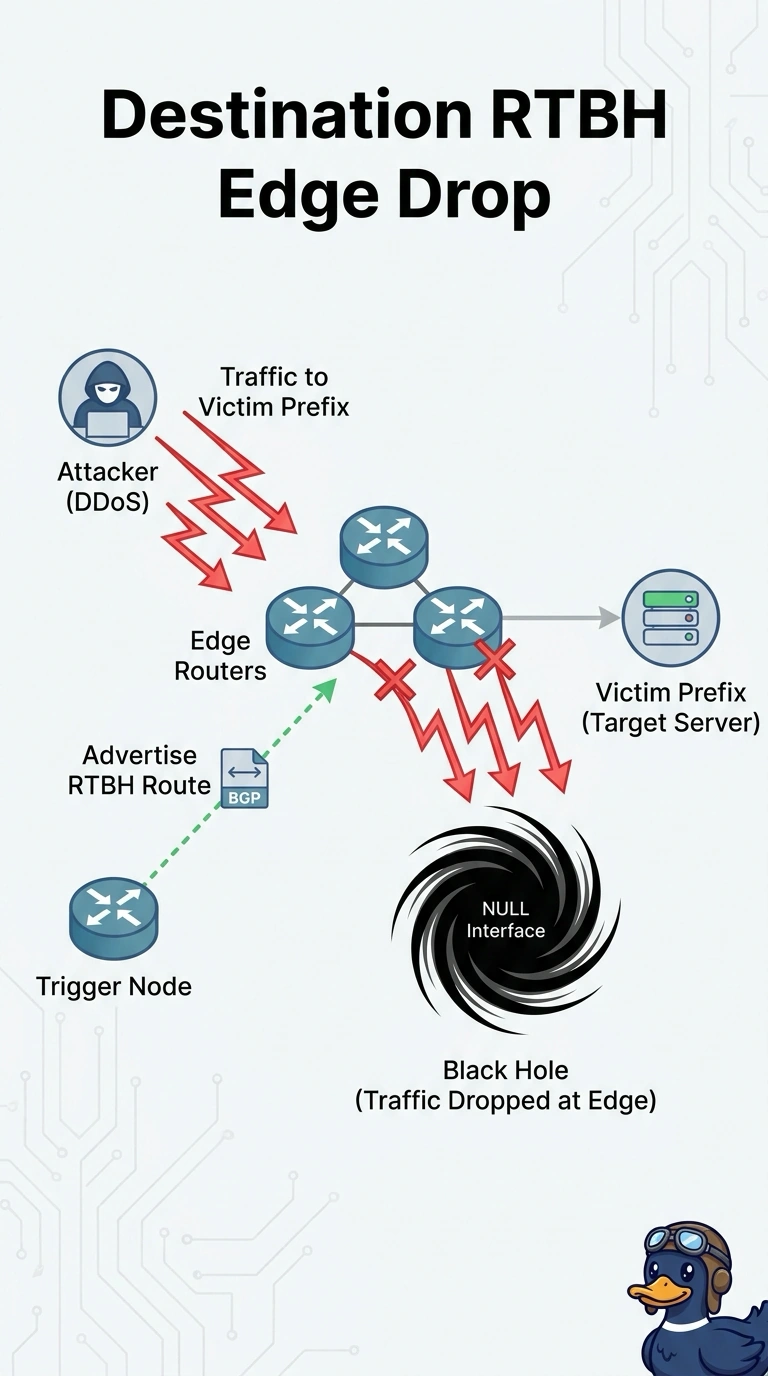
Short Explanation
You trigger a destination RTBH for the victim prefix so your participating edges drop the flood on ingress before it crosses the backbone. Destination RTBH also drops legitimate traffic to the victim prefix. Filtering at a receiving edge protects the downstream core but cannot recover capacity already consumed on its ingress link.
Full Explanation
Destination RTBH is the BGP-triggered edge discard design for a victim destination under volumetric attack. The trigger advertises a destination RTBH route for the victim prefix with a discard next hop, commonly via iBGP from a trigger router, and participating provider edges install a discard entry that drops every matching packet on ingress. That stops the flood before it traverses core links and router resources, which meets the requirement for BGP-triggered destination discard across participating provider edges. Destination RTBH also drops legitimate traffic to the victim prefix. Filtering at a receiving edge protects the downstream core but cannot recover capacity already consumed on its ingress link. A hand-updated source access list on the edge fails by concept because it filters by source rather than discarding the flooded destination, requires manual edits during an active attack, and does not provide a network-wide BGP trigger. MACsec encryption on the edge Ethernet hop fails by concept because it provides hop confidentiality and integrity and does not test or discard destination flood traffic. A policy that steers the victim prefix with higher local preference deeper into the core fails by concept because it attracts more best-path selection toward the victim and keeps attack traffic in the network instead of discarding it at ingress.