
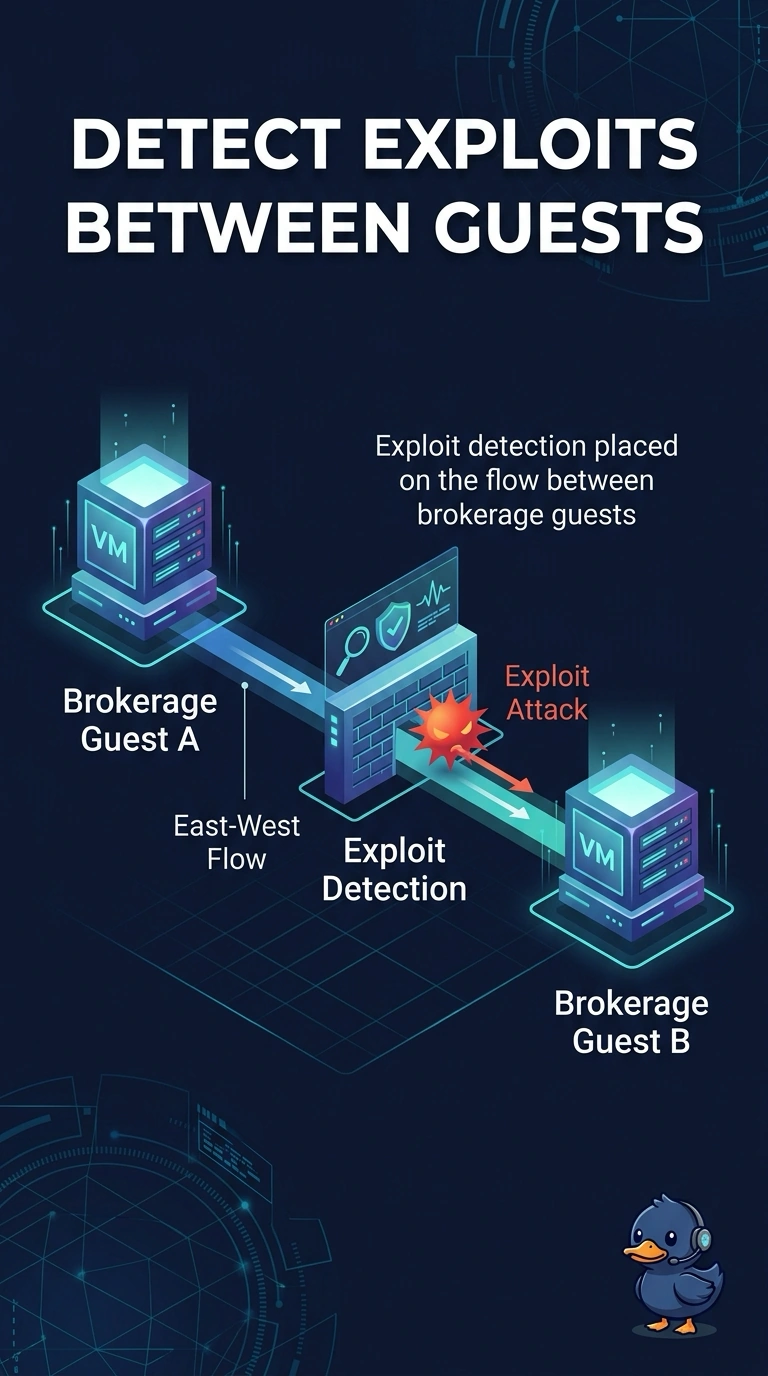
DNS queries from a brokerage workload look clean, but exploit attempts appear only on the east-west flow between two guests. Which service can see that activity?
Select an answer to reveal the explanation.
Short Explanation
The alarm belongs on the hallway where the trouble actually walks, not on a door that stays quiet. You place exploit detection on the east-west flow between the two guests. DNS security, a disk malware scan, and a resolver log watch queries, an image, or names, and your exploit is on none of those.
Full Explanation
DNS security is placed where queries can be seen. Exploit detection and malware detection are placed on the workload or the flow they were built to watch. These queries are clean, and the exploit is visible only on the east-west flow, so exploit detection on that flow is the service that can see it. A DNS security service and a resolver log both watch names. A disk scan watches an image the flow does not touch. Exploit detection placed on the flow between those two brokerage guests is the design that meets this requirement. A DNS security service inspecting the queries that are already known clean is the wrong fit because DNS security sees queries, and these queries are clean, so it never observes the exploit on the flow. Malware scanning of a disk image that this east-west flow does not touch is the wrong fit because malware scanning of a disk sees the image it was aimed at, and this exploit is on the flow instead. A recursive resolver log that records names rather than the east-west packets is the wrong fit because a resolver log records queried names, and the exploit packets between the guests are not in that log. Exam caveat: A DNS security service does not inspect a disk, and a disk or name log does not see an exploit that exists only on a flow. Place each service where that activity appears. Operational check: Confirm the exploit detector is attached to the east-west flow and that the clean DNS logs were not used as the only evidence of the attempt.