
One amplification signature is flooding a single hosted name, other services on that prefix must stay up, and the prefix must remain on its current path. What should the provider install?
Select an answer to reveal the explanation.
Short Explanation
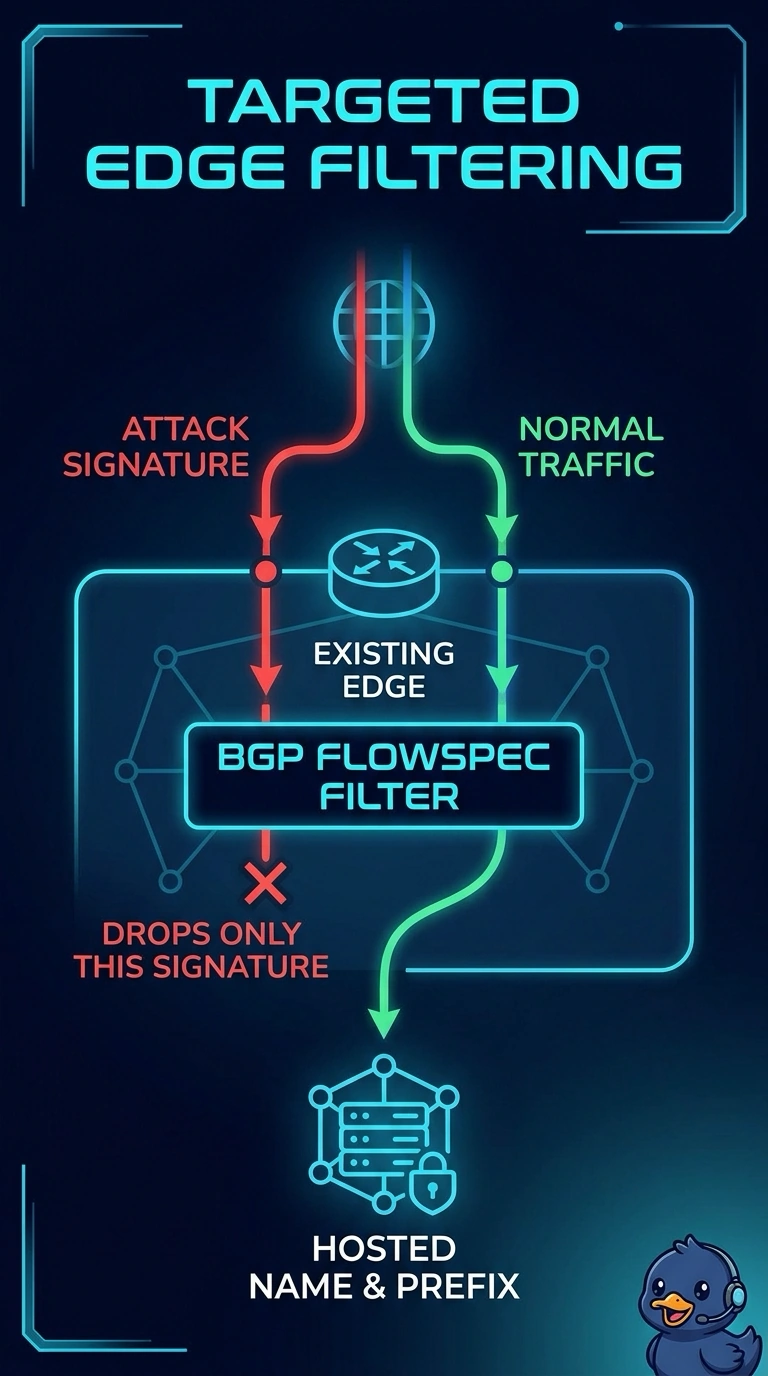
You close one noisy lane and leave the rest of the bridge open where it already stands. Distribute a FlowSpec discard rule for the attack’s expressible header fields, such as destination prefix, protocol, ports, or packet length, and verify the rule installs upstream of any saturated link. You stay on the current path while a whole-prefix discard would darken services you must keep up.
Full Explanation
Scrubbing, destination-based black-holing, and FlowSpec have different blast radii. This flood is one amplification signature toward one name, the rest of the prefix must stay up, and the prefix must remain on its current path. Distribute a FlowSpec discard rule for the attack’s expressible header fields, such as destination prefix, protocol, ports, or packet length, and verify the rule installs upstream of any saturated link. That keeps the edge and path in place while only the matched header combination is dropped. A remotely triggered black hole for the entire prefix that holds the attacked name is the wrong fit because a destination RTBH route discards matching traffic; it does not simply withdraw the prefix, so discarding the whole destination prefix still silences the other services that must stay reachable on that same prefix. A black hole for every prefix learned at that provider edge, not just the target is the wrong fit because widening the discard to every prefix takes down customers that are not under attack. A scrubbing redirect that withdraws the prefix from its current path for cleaning is the wrong fit because it moves the prefix off the current path, violating the requirement to keep the prefix there. Operational check: Confirm only the matched headers drop and other services on the prefix still answer.