
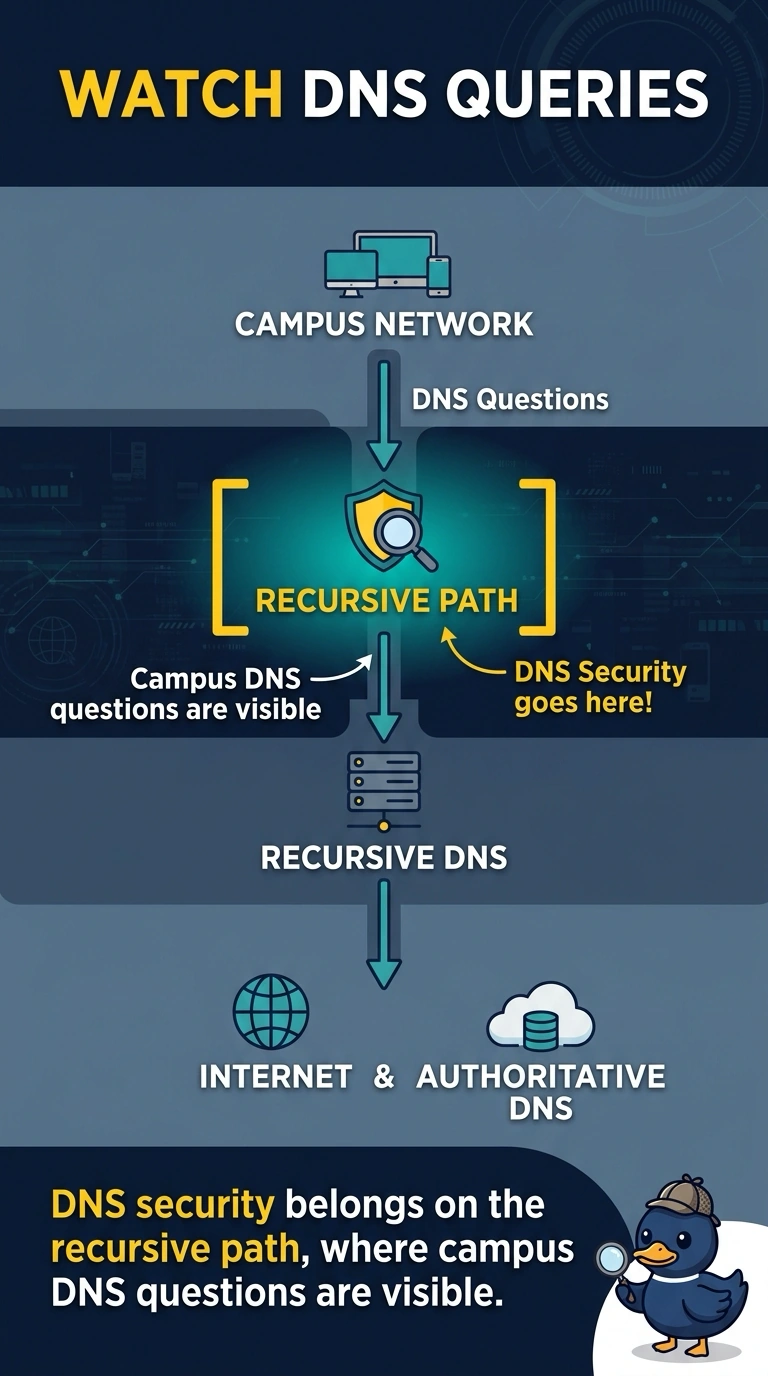
A university security team must watch recursive DNS queries for a tunneling domain, so the control has to see the questions themselves. Which placement can see those queries?
Select an answer to reveal the explanation.
Short Explanation
Searching the closet tells you nothing about a question that was never spoken. You place DNS security where the recursive queries are visible to the campus resolvers. Malware scanning of disks, exploit detection on unrelated flows, and a web-proxy URL check do not see those questions.
Full Explanation
DNS security sees DNS queries, so it has to sit where the recursive questions are visible. Malware detection sees the workload or the files it was placed on, and it does not see a query that misses that sensor. Exploit detection sees the flow it was placed on. A web-proxy check sees HTTP URLs after resolution. Watching for a tunneling domain in campus DNS means the DNS security service is on that recursive path. DNS security on the recursive path, where the campus DNS questions are visible is the design that meets this requirement. Malware detection on endpoint disks, a file scan that does not inspect the DNS query is the wrong fit because a disk scan looks at files on the endpoint and does not see the recursive DNS questions leaving the campus. Exploit detection on application flows that do not carry the recursive DNS questions is the wrong fit because exploit detection on a flow sees the packets it was placed on, and these application flows do not carry the queries. A web-proxy inspection of HTTP URLs, looking at web requests rather than DNS questions is the wrong fit because a web-proxy URL check sees HTTP requests after a name is resolved, and it does not see the DNS question itself. Exam caveat: Malware detection and exploit detection are valuable on the workload or the flow they can see. They do not inspect a DNS question that does not pass through that sensor. Operational check: On the campus resolvers, confirm the DNS security service receives the recursive queries and that disk scans are not the only control in front of this tunneling domain.