
A flood is one UDP signature aimed at a customer prefix, and other flows to that prefix must stay up. Which mitigation drops only the signature?
Select an answer to reveal the explanation.
Short Explanation
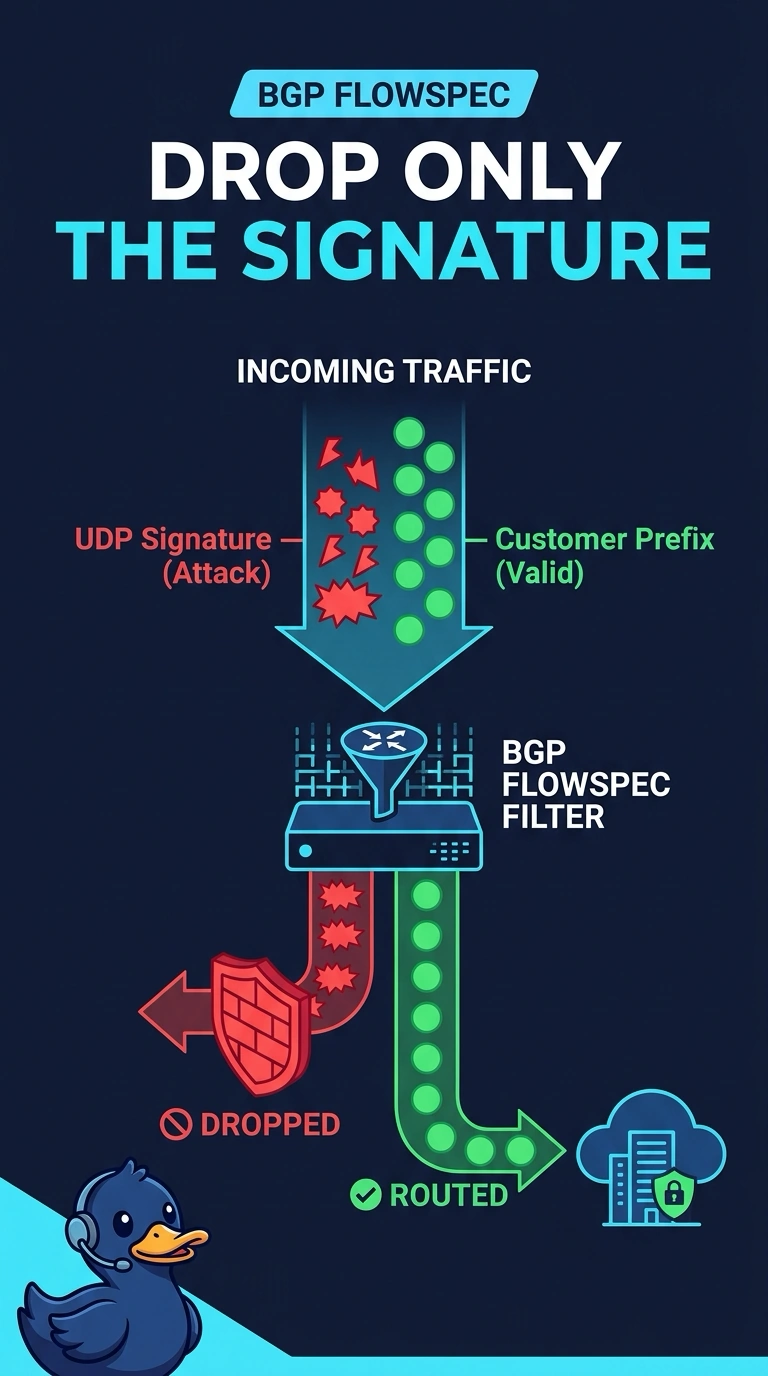
You refuse the bad package but you keep the street open for everyone else. Distribute a FlowSpec discard rule for the attack’s expressible header fields, such as destination prefix, protocol, ports, or packet length, and verify the rule installs upstream of any saturated link. You leave other flows alone instead of black-holing the whole prefix or sending everything to a scrubber.
Full Explanation
Distribute a FlowSpec discard rule for the attack’s expressible header fields, such as destination prefix, protocol, ports, or packet length, and verify the rule installs upstream of any saturated link. That rule matches the UDP flood on destination prefix, protocol, ports or packet length and applies a discard action only to that flow, so the customer prefix remains routed and all other flows to the same prefix continue to forward. A destination remote black hole route for the entire customer prefix discards all matching traffic for that prefix at the edge, which removes legitimate flows with the attack and is wider than the required signature drop. A destination remote black hole route for the provider aggregate discards all matching traffic for the aggregate covering this customer and its neighbors, which takes neighbors offline with the victim and is wider than one signature to one prefix. A scrubbing diversion that redirects the whole prefix off-net to be cleaned and then returned changes the path for all traffic instead of dropping the signature in place. Exam caveat: Flowspec is only as narrow as the match you distribute, and a loose match can discard legitimate traffic that shares the same fields. Operational check: Confirm the flowspec rule matches the UDP signature only, and confirm other flows to the same prefix still forward after the rule is installed.