
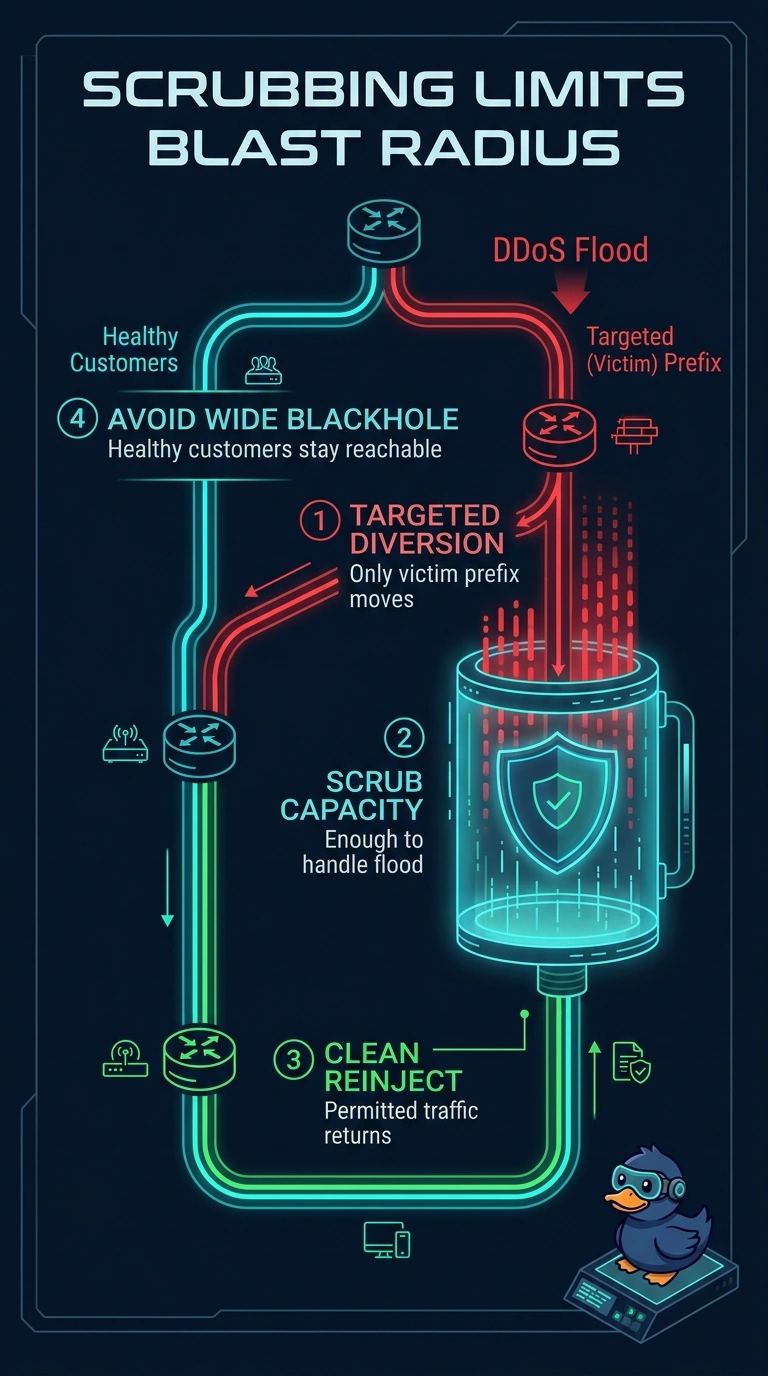
A hosting provider sees a volumetric flood toward one customer prefix while every other customer on those routers stays healthy. Divert the targeted prefix to a scrubbing service with enough capacity and reinject permitted traffic. Test convergence and existing-session behavior; diversion does not guarantee zero interruption. Which response limits blast radius to the attacked prefix while preserving legitimate sessions where possible without discarding the other customers?
Select an answer to reveal the explanation.
Short Explanation
You would clean one smoky room rather than board up the whole hotel. Divert the targeted prefix to a scrubbing service with enough capacity and reinject permitted traffic. Test convergence and existing-session behavior; diversion does not guarantee zero interruption.
Full Explanation
Divert the targeted prefix to a scrubbing service with enough capacity and reinject permitted traffic. Test convergence and existing-session behavior; diversion does not guarantee zero interruption. That qualified diversion keeps blast radius on the attacked prefix while giving legitimate sessions a path back, which is why it fits a victim that must stay reachable and neighbors that must stay healthy. Remote triggered black-hole of only the attacked prefix drops the flood and the good sessions together, so it sacrifices the victim instead of preserving sessions where possible. Remote black-hole of every prefix the provider originates expands the outage to healthy customers that were never under attack and violates the requirement to limit scope. A BGP flowspec rule that discards all traffic toward the provider address aggregate is also provider-wide filtering that drops flows for customers who are not under attack. Operationally confirm the diversion covers only the targeted prefix, scrubbing capacity is sufficient, clean traffic is reinjected on the intended path, and other customer prefixes stay reachable, while validating how existing sessions reconverge.