
The orchestrator calls the cloud API over TLS, but only the server presents a certificate and the client is not proven. Which change fits?
Select an answer to reveal the explanation.
Short Explanation
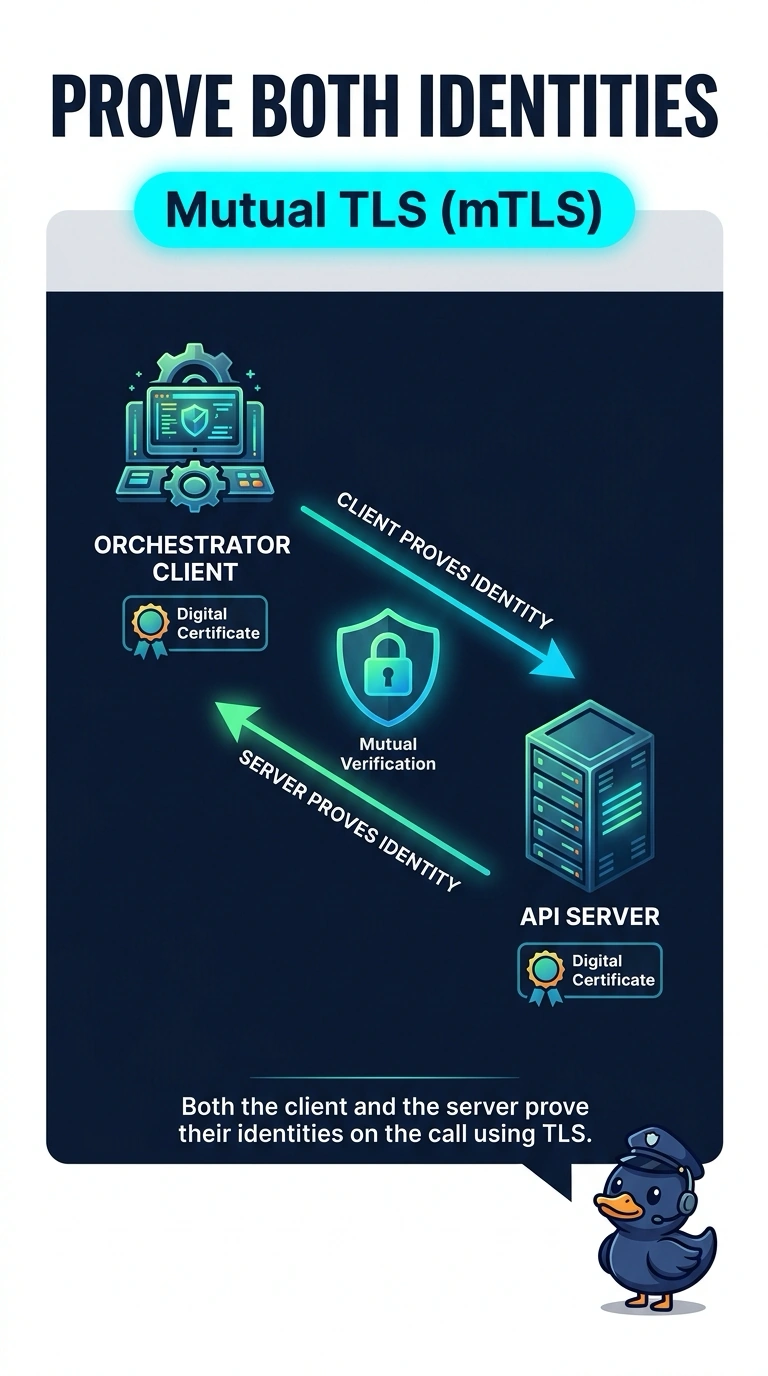
A badge check at the door still needs the visitor to show a badge, not only the building. You move the orchestrator API call to mutual TLS so both the client and the server prove who they are. Server-only TLS, an address filter, and tenant segmentation leave the caller unproven.
Full Explanation
TLS protects the channel and, in the usual server-authenticated form, proves the server. Mutual TLS proves both the client and the server, which is what this orchestrator call is missing. Leaving TLS as server-only keeps that gap. An access list can restrict which addresses connect and still does not authenticate the orchestrator. Tenant segmentation keeps workloads apart and does not prove an API client. Mutual TLS so both the orchestrator client and the API server prove their identities on the call is the design that meets this requirement. TLS left as it is, with the server proven and the orchestrator client still not proven is the wrong fit because server-only TLS proves the server and leaves the orchestrator client unproven, which is the current gap. An access list on the API subnet that filters source addresses and does not prove the caller is the wrong fit because an access list can limit addresses and still does not authenticate the orchestrator that places the call. Tenant segmentation that separates guest networks and does not authenticate the API caller is the wrong fit because tenant segmentation keeps workloads apart and does not prove the identity of the API client. Exam caveat: Mutual TLS proves both ends of this API call, and it does not by itself keep the cloud control plane unreachable from a tenant workload that should never call it. Operational check: Confirm the orchestrator presents a client certificate and the API requires it, and confirm a caller with no client certificate is rejected.