
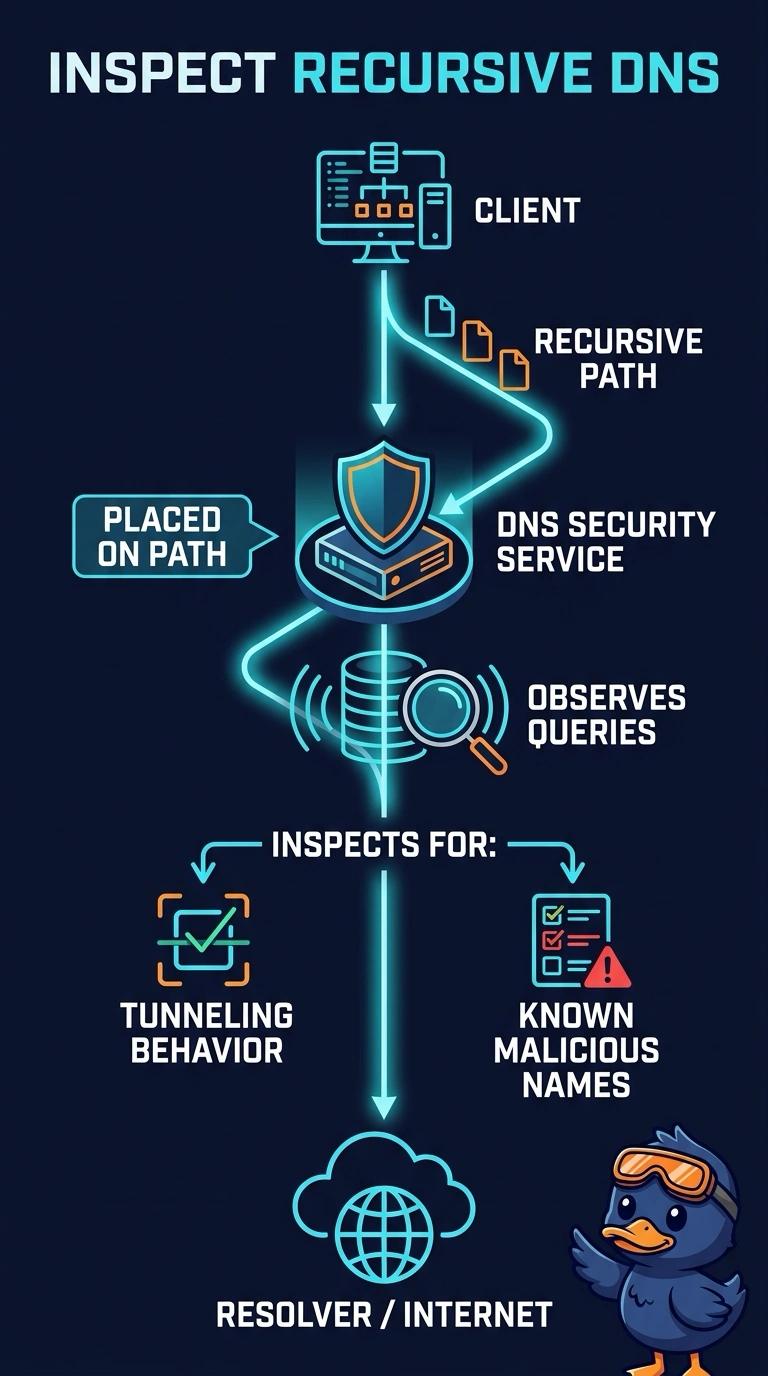
A school cloud must inspect recursive queries for tunneling behavior and for lookups of known malicious names. Which service is in a position to see that traffic?
Select an answer to reveal the explanation.
Short Explanation
A guard at the mail slot sees the envelopes, not the papers inside the desk. You place DNS security where the school recursive queries can be observed. Malware detection on the guest, exploit detection on a workload flow, and a scanner of stored files do not see those queries.
Full Explanation
DNS security has to sit where queries are visible, because tunneling and malicious-name lookups are in the query stream. Malware detection and exploit detection see the workload or the flow they were placed on. A scanner of stored files sees the disk. None of those three observes the recursive queries, so the school places DNS security on the resolver path. A DNS security service placed on the recursive path where those queries can be observed is the design that meets this requirement. A malware detection service that inspects the guest workload and does not see the queries is the wrong fit because malware detection sees the workload it was placed on, and it does not answer or inspect recursive queries. An exploit detection service placed on a workload flow rather than on the resolver path is the wrong fit because exploit detection sees the workload flow it was placed on, not the names asked at the resolver. A stored-file scanner that looks at binaries on disk and does not receive the query stream is the wrong fit because a file scanner sees only stored binaries, and the recursive queries are not files sitting on that disk. Exam caveat: A DNS security service does not scan a disk, and a workload scanner does not become a recursive resolver just because both are called cloud security. Operational check: Confirm the DNS security service is on the path of the school recursive queries and that a test lookup of a known malicious name is visible there.