
A volumetric flood with a clear signature targets one customer prefix at a cloud edge, and that prefix must stay reachable while the attack packets are dropped at the edge. Which mitigation matches?
Select an answer to reveal the explanation.
Short Explanation
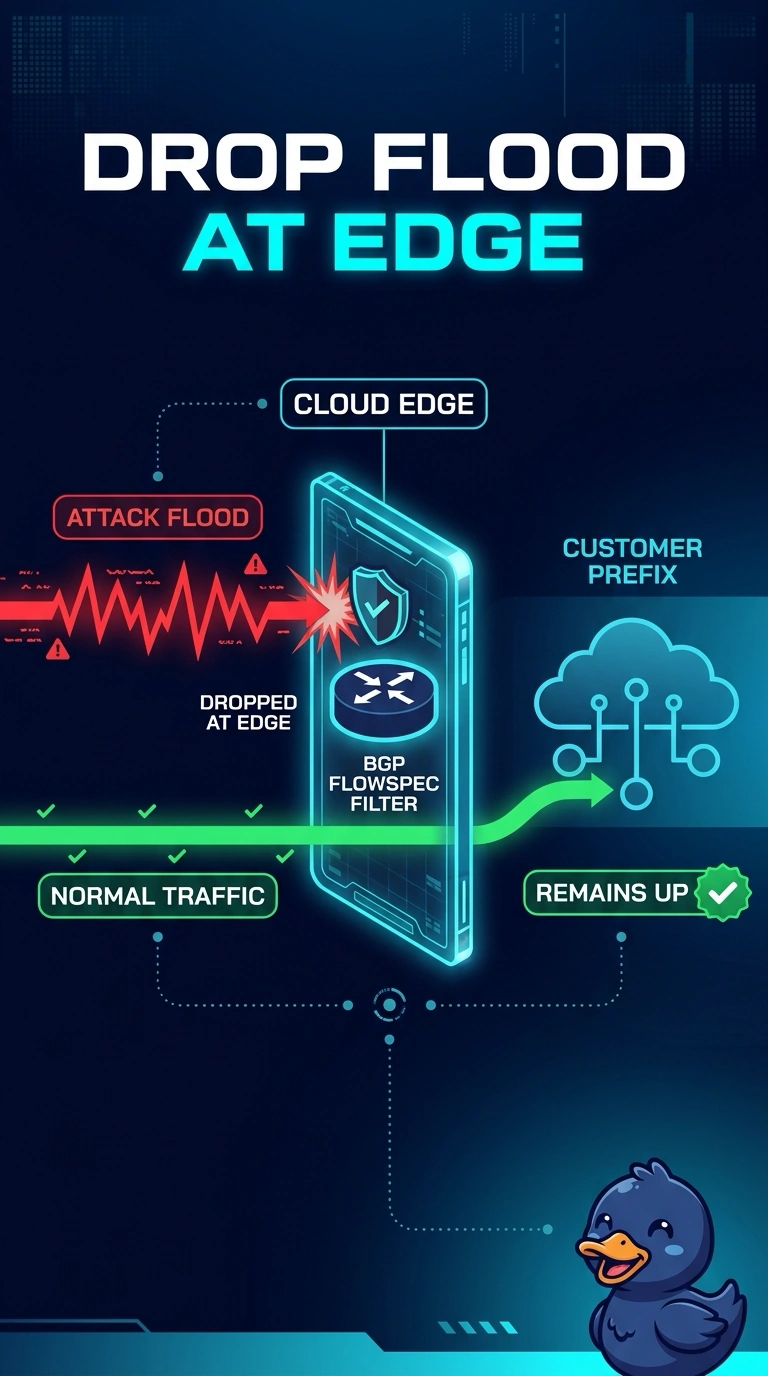
You can keep the customer prefix reachable by using BGP FlowSpec to drop the attack flow at the edge. A provider-wide black hole affects far more traffic, while a black hole for the attacked prefix takes that customer offline; a scrubbing redirect cleans traffic off-path rather than dropping it at the edge.
Full Explanation
BGP FlowSpec matches the attack’s expressible header fields—such as destination prefix, protocol, ports, or packet length—and distributes a rule to drop matching packets at the edge. That fits the requirement because the customer prefix remains advertised and reachable while the identified attack flow is discarded. A black hole covering the whole provider has an excessive blast radius: it discards traffic well beyond the attacked customer prefix and can remove reachability for other customers. A black hole limited to the attacked prefix still discards all traffic to that prefix, taking the customer offline rather than keeping the prefix reachable. Redirecting traffic to a scrubbing center sends it off-path to be cleaned; that is a different mitigation from dropping the attack flow at the edge. Exam caveat: a prefix black hole or scrubbing redirect can be appropriate when the goal is to protect the provider by sacrificing the attacked prefix or to clean traffic off-path, but neither meets this specific requirement. Practical check: verify that the FlowSpec rule installs at the edge, drops only the matching attack flow, and leaves the customer prefix and other prefixes reachable.