
A school district must inspect recursive DNS queries for newly registered domains used by phishing. Disk scans and other flow inspection do not see those queries. What should be added?
Select an answer to reveal the explanation.
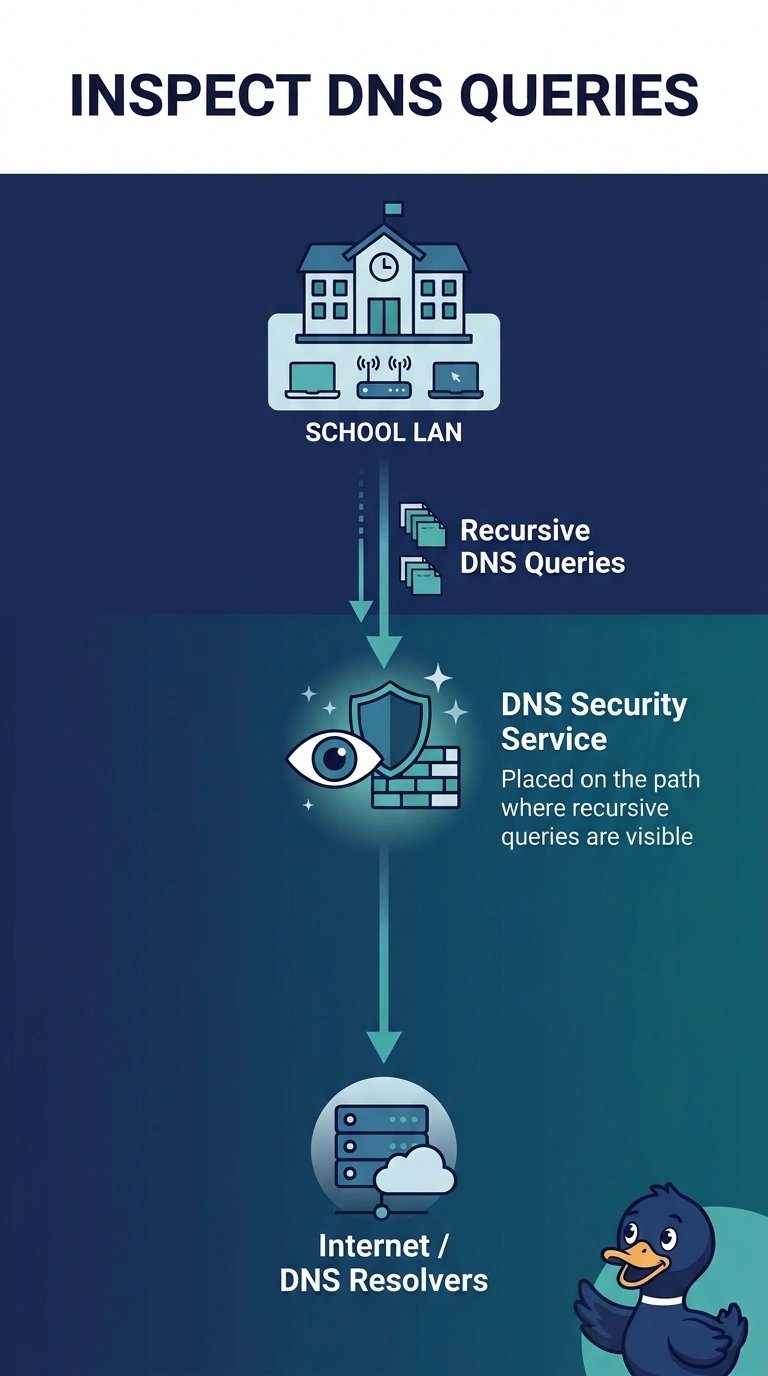
Short Explanation
You are the guard at the question window hearing the questions, and a search of the desk drawers does not help. Use DNS-layer security that can observe the query and apply the configured phishing or domain-risk categories. Newly seen and newly registered are different properties; domain age alone does not establish phishing.
Full Explanation
DNS security has to sit where queries are visible, because that is where a query can be judged. The district needs to see recursive lookups for phishing, and the disk scans and other flow inspection already in place do not see those queries. Use DNS-layer security that can observe the query and apply the configured phishing or domain-risk categories. Newly seen and newly registered are different properties; domain age alone does not establish phishing. A DNS security service placed on the path where the school recursive queries are visible is the design that meets this requirement. Malware detection on student-device disks where the recursive query path is not visible is the wrong fit because malware detection on a disk scans stored content and does not see or answer the recursive DNS queries. Exploit detection on an application flow that does not carry those recursive DNS queries is the wrong fit because it does not observe the recursive queries the district must inspect. Link encryption between two school switches on a hop that does not export DNS queries is the wrong fit because encrypting a switch hop protects frames on that link and does not inspect the DNS questions. Operational check: Send a test query for a suspect name and confirm the DNS security service logs that query, while the disk scanner shows no DNS record for it.