
Tenants in a public cloud resolve names through the provider recursive DNS. The security team must see lookups for a known malware domain and has no access to tenant guest disks. Which service can see those lookups?
Select an answer to reveal the explanation.
Short Explanation
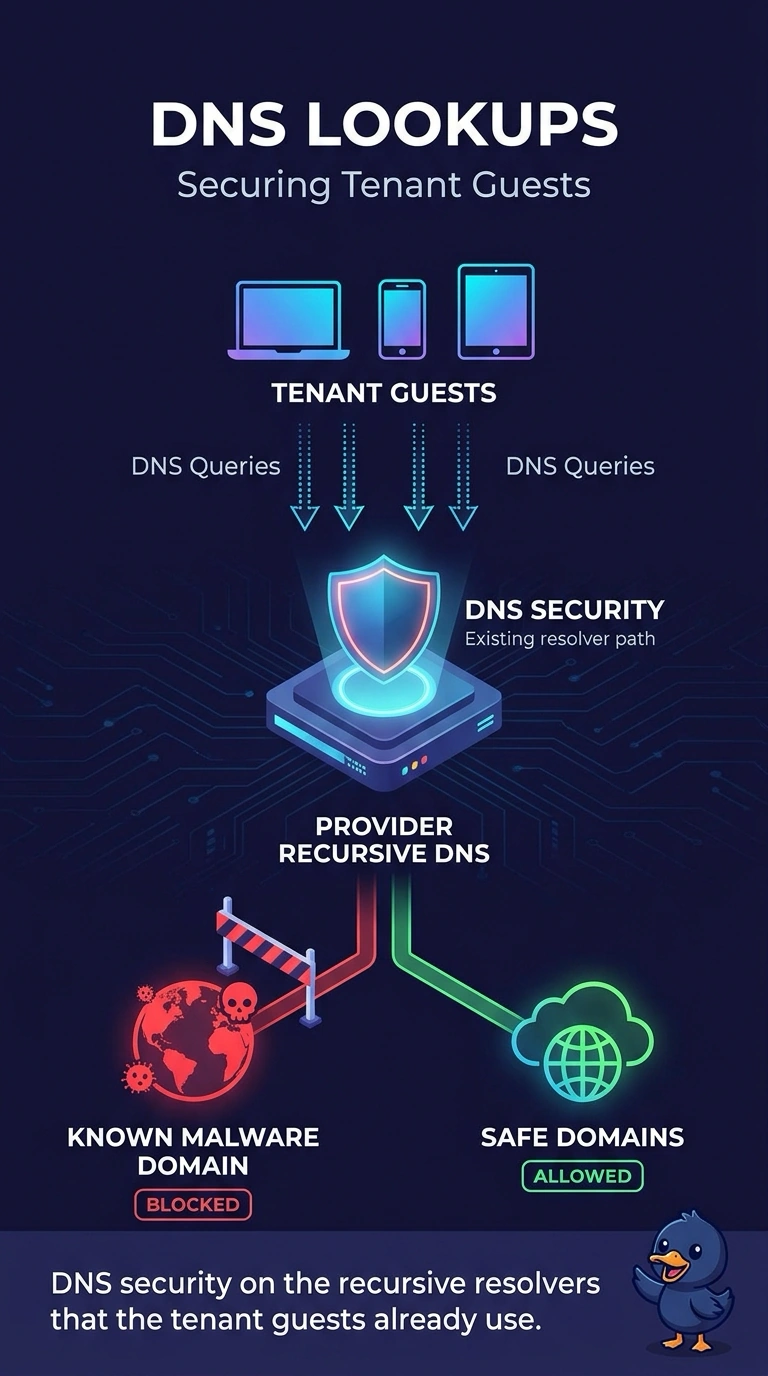
You cannot catch a whispered name by searching a locked room you are not allowed to enter. You watch the recursive DNS path the tenants actually use. A disk malware scan, an exploit detector on another flow, or DNS security on a resolver they do not ask does not see those lookups.
Full Explanation
DNS security sees queries, so it has to sit on the recursive path the tenants actually use. Malware detection sees a workload disk, which this team cannot access, and a disk scan does not see a recursive query. Exploit detection sees the workload or flow where it was placed, not the DNS lookup on a different path. The same DNS security service on a resolver the tenants skip also sees nothing, because the queries are not there. DNS security on the recursive resolvers that the tenant guests already use is the design that meets this requirement. Malware detection aimed at files on the tenant disks the team cannot read is the wrong fit because disk malware detection sees files on a workload, and this team cannot read those tenant disks. Exploit detection on application flows that do not carry the DNS lookups is the wrong fit because exploit detection sees the flow it was placed on, and these lookups are DNS queries instead. DNS security placed on an internal resolver that tenant guests do not query is the wrong fit because a resolver that tenants do not use has no view of the queries they send to another resolver. Exam caveat: DNS security tells you a name was queried. It does not prove a guest is infected, and it does not scan a disk. Follow a hit with the control that can see the workload. Operational check: Query the known malware domain from a test tenant, confirm the recursive resolver logs the lookup, and confirm a resolver the tenant does not use stays silent.