
A volumetric flood targets one customer prefix. Edge filters cannot absorb the volume, and legitimate packets to that prefix must still be delivered. The rest of the provider must stay up. Which mitigation fits?
Select an answer to reveal the explanation.
Short Explanation
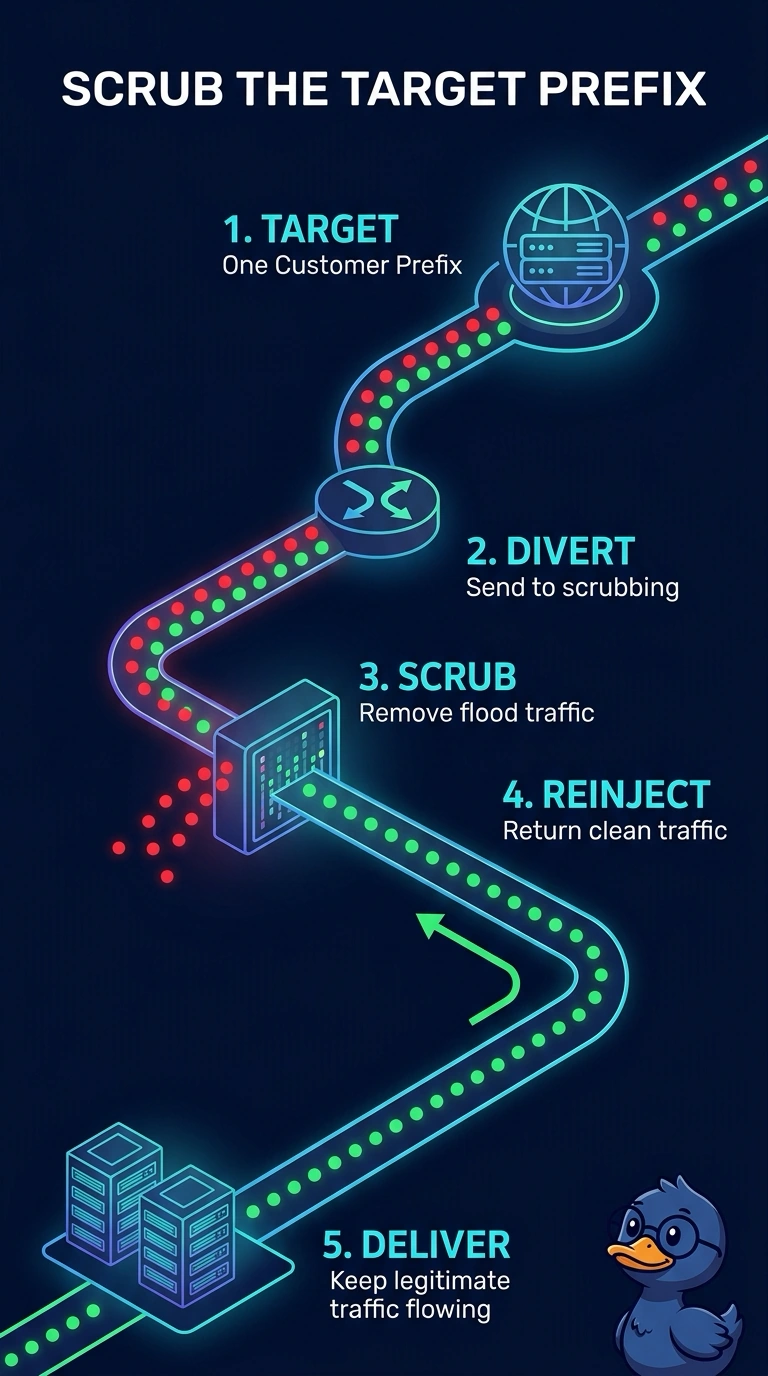
When the flood is too large for edge filters, you can send the attacked prefix to a scrubbing center, where harmful traffic is removed and clean traffic is returned. This targeted diversion keeps legitimate packets flowing and avoids taking down the rest of the provider. Black-holing the prefix, black-holing the provider aggregate, or dropping every packet to the prefix would also discard legitimate traffic or affect other customers.
Full Explanation
Diverting the attacked prefix to a scrubbing center and reinjecting clean traffic meets the requirement: the center handles the volume that edge filters cannot absorb, while legitimate packets to the customer prefix can still be delivered. A black hole aimed at only that prefix discards the attack traffic, but also discards the legitimate packets that must survive. A black hole for the provider aggregate containing the prefix has a much larger impact, taking down other customers along with the target. A flowspec filter that drops every packet addressed to the attacked prefix also discards legitimate traffic; despite being a filter, it has the same destination-wide effect as a prefix black hole. The key distinction is whether mitigation preserves clean traffic and limits its impact to the attacked customer. Exam caveat: scrubbing depends on the center having enough capacity and on clean traffic being reinjected correctly; diversion alone does not guarantee delivery. Practical check: during a lab flood to one prefix, verify that only that prefix is diverted, legitimate packets return from the scrubbing center, and other provider prefixes remain reachable.