
A transit router accepts many prefixes from a customer, including prefixes the contract does not allow that customer to advertise. What control limits the accepted prefixes?
Select an answer to reveal the explanation.
Short Explanation
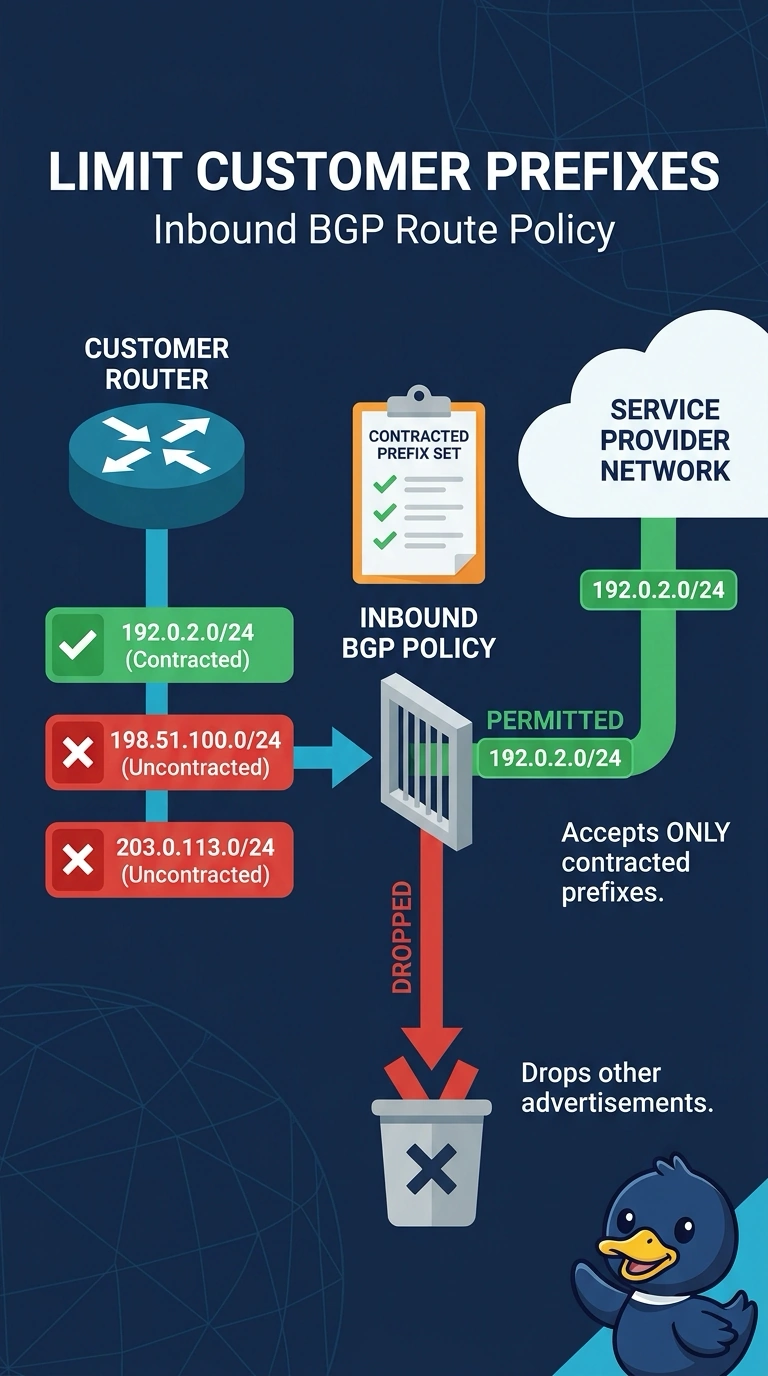
Think of a guest list at the door for routing updates. You apply an inbound BGP route policy to permit only prefixes in the contracted set and drop other advertisements. You can distinguish this from uRPF checks on packet sources, TACACS operator accounting, and MACsec encryption on the Ethernet hop.
Full Explanation
Apply an inbound BGP route policy that permits only prefixes in the contracted prefix set and drops other advertisements. The contract specifies which prefixes the customer may advertise, and other prefixes are being accepted, so the BGP session must filter updates against that set. This is BGP update filtering. Unicast reverse-path forwarding that drops spoofed packet sources on the arrival interface is the wrong fit because reverse-path checks validate source addresses on forwarded packets arriving at an interface; they do not filter advertised prefixes. TACACS logins that account for operators on the router and do not filter prefixes are the wrong fit because TACACS accounts for operator administration and does not decide which customer prefixes are accepted. MACsec on the Ethernet hop that encrypts the link and does not limit accepted prefixes is the wrong fit because MACsec encrypts one Ethernet hop but does not filter prefixes learned from the customer session. Exam caveat: A route policy on the session limits BGP advertisements; it is distinct from reverse-path checks, operator login, and hop encryption. Operational check: Have the customer advertise a prefix outside the contract and confirm the policy rejects it, while a contracted prefix is still accepted on the same session.