
A regional university hosts admissions and online learning portals in its campus data center. A DoS flood targets one web service with high-rate UDP packets to a single destination port, while other services using the same server prefix must stay reachable. Operators need to stop only the attack flow at provider edges with minimal collateral impact. The affected edges have supported FlowSpec filtering and enough remaining ingress capacity. Which control matches the requirement?
Select an answer to reveal the explanation.
Short Explanation
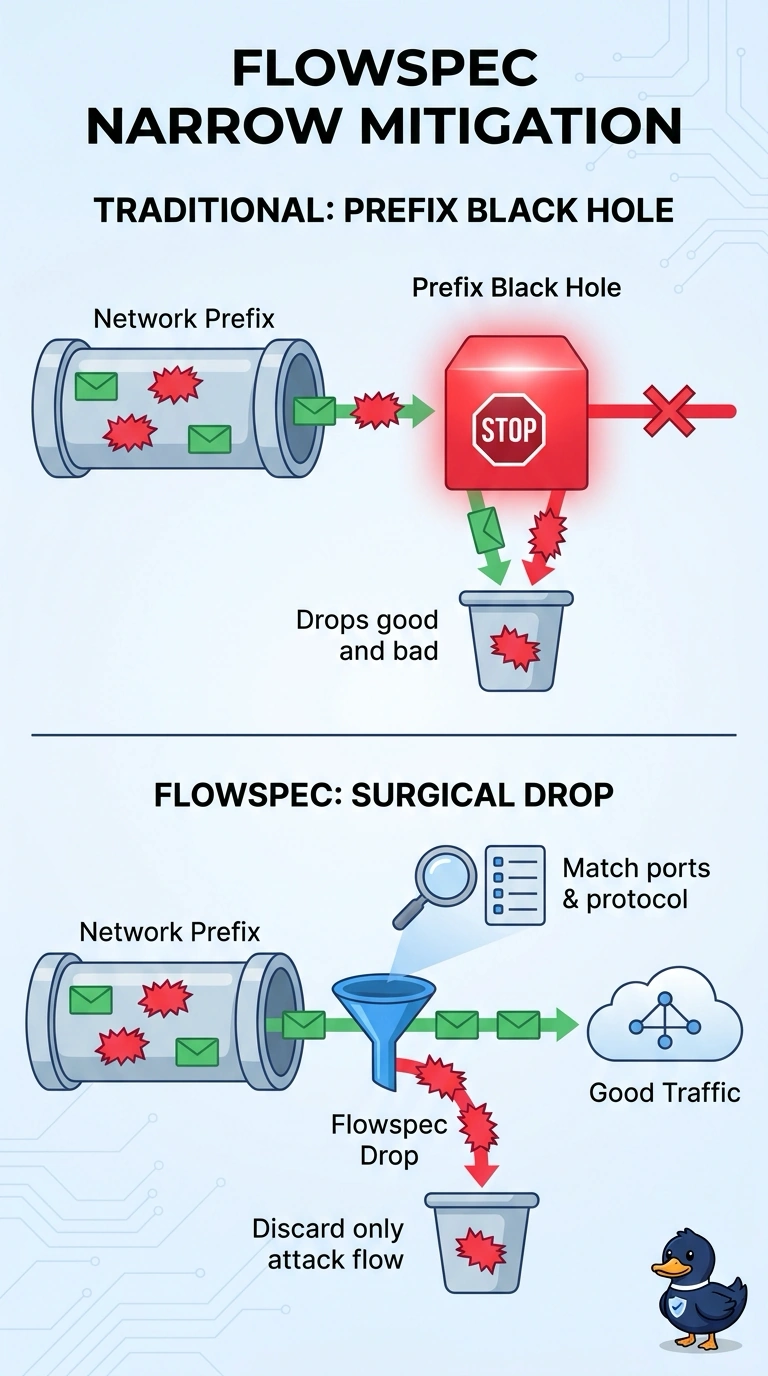
You want to block just the attack stream while keeping the rest of the prefix online. A Flowspec rule matching that flow gives you that surgical discard, while black-holing a prefix or a whole provider takes good traffic down with it.
Full Explanation
BGP Flowspec is the right control because it propagates a match-action rule that identifies only the attack flow by destination, protocol and ports and installs a discard at participating edges. That surgical filter stops the flood at ingress while legitimate services on the same prefix continue to forward. The rule drops every packet matching the specified destination, UDP protocol, and destination port. Legitimate packets with the same match are also discarded, so verify that the match identifies traffic the operator intends to block. Destination-based black-holing of the entire victim prefix does not meet that goal because it discards every packet toward the destination, dropping legitimate sessions along with attack packets and creating much wider collateral impact. Provider-wide black-holing is worse because discarding all traffic toward the upstream provider network denies service to all customers behind it, which is an induced outage rather than mitigation. TACACS+ authentication for operator logins is out of scope because it secures management-plane access to routers and has no effect on data-plane forwarding, so it cannot match or drop a flood. In operation the Flowspec rule is announced for the attack duration and withdrawn afterward to restore normal forwarding without leaving broad discard in place.