
A regional hospital runs its patient portal on backend servers in two data centers behind a service-provider load balancer. One server must be able to fail so new requests can be directed automatically to the surviving backend after failure detection, with the balancer detecting the failure automatically. What fits?
Select an answer to reveal the explanation.
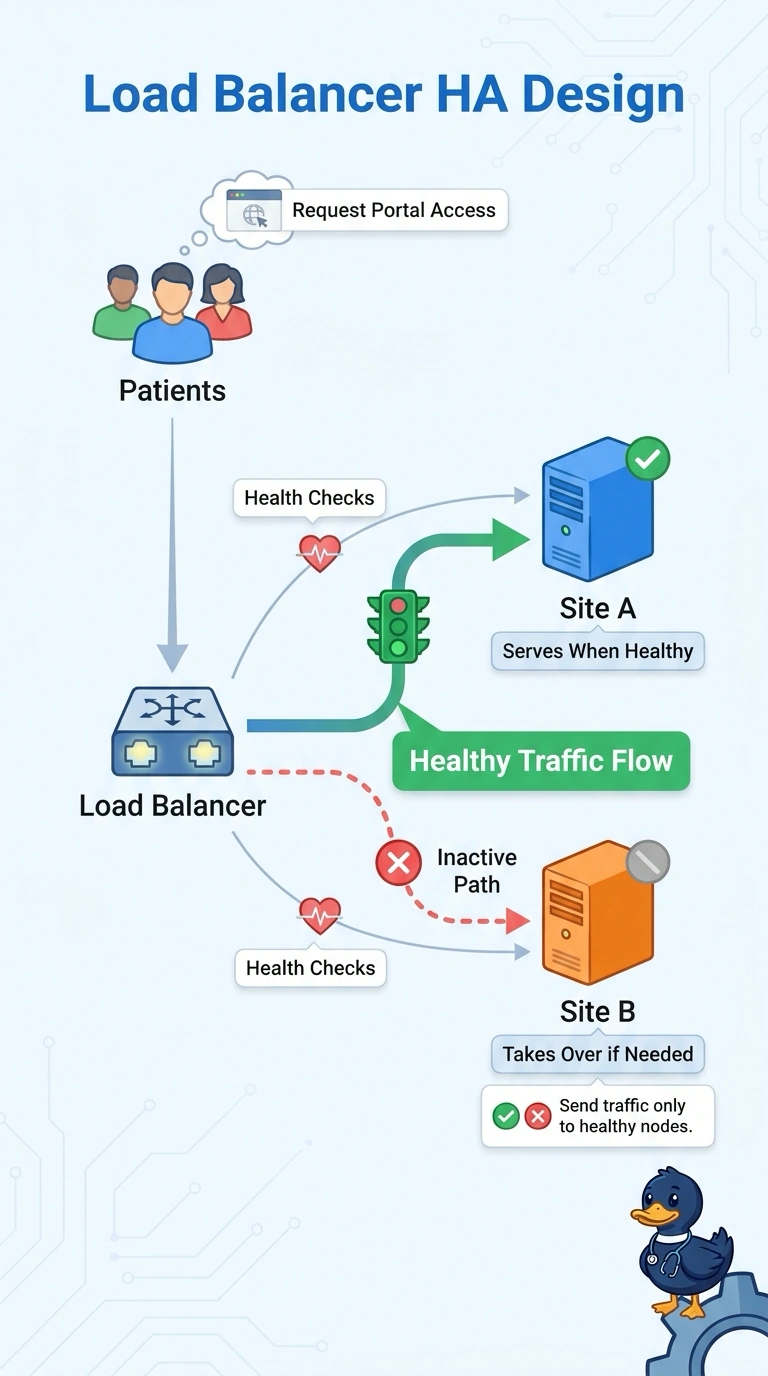
Short Explanation
You configure application health checks and a second backend so new requests can use a healthy server after a failure is detected. You are making sure new patient requests still find a healthy backend after one fails.
Full Explanation
Configure the provider load balancer with application health checks pointing to backend nodes in two separate sites or failure domains, forwarding only to nodes that pass checks. This is the correct availability model because health checking provides failure detection while dual nodes provide a surviving target, so loss of one backend results in automatic steering to the remaining healthy node without manual intervention. The design also isolates site-level failures when nodes are placed in different locations. A single backend with no health monitoring is the wrong fit because the balancer has no alternate target and no way to detect failure, so one server fault becomes a full service outage. Two backends with load distribution but no health checks or failover control is the wrong fit because the balancer continues to send traffic to a failed node, causing intermittent failures and poor availability despite having capacity. Adding an unrelated service on a separate single server is the wrong fit because redundancy for one application does not transfer to another, leaving the patient portal still exposed to a single point of failure. Exam caveat: redundancy without health checking is not high availability. Operational check: Stop one backend, verify its removal after the configured failure threshold, and verify successful new requests through the remaining backend. Existing connections and application sessions need separate recovery or state handling.