
The cloud fabric already speaks OSPF to two physical routers. Both links have equal cost, but traffic uses only one next hop. The operator wants both next hops used. Which change fits this fabric?
Select an answer to reveal the explanation.
Short Explanation
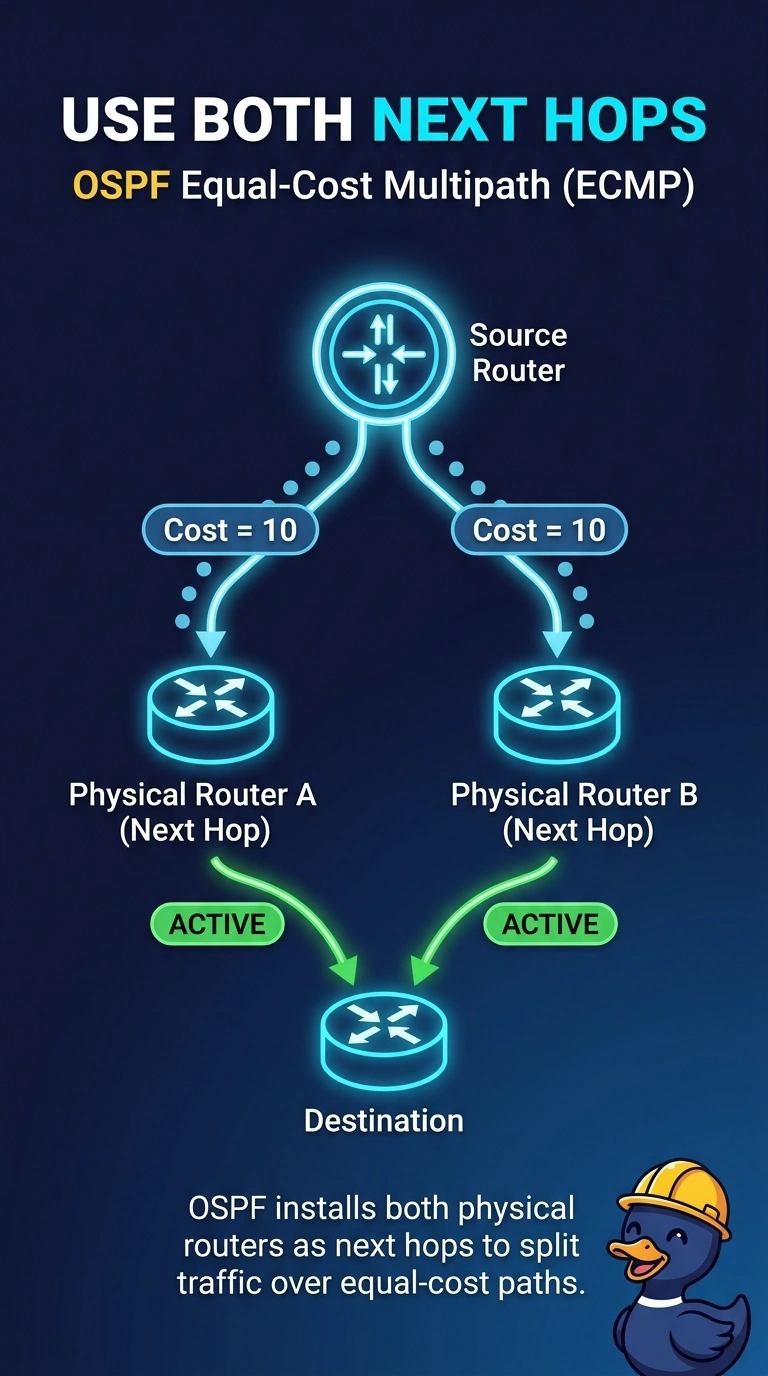
Two equal doors do no good if every visitor is sent through only one. You turn on OSPF equal-cost multipath so both physical routers stay next hops. A single static default, BGP multipath with no BGP session, or IS-IS on an OSPF fabric does not use both of these links.
Full Explanation
Equal-cost multipath keeps more than one next hop alive when the costs match. This fabric already has two equal-cost OSPF paths to the physical routers, so OSPF equal-cost multipath is the design that uses both. One static default is a single exit, not multipath. BGP multipath is the right tool when BGP is the protocol that has the equal paths. IS-IS multipath belongs on an IS-IS fabric. The protocol already in use here is OSPF. OSPF equal-cost multipath that installs both physical routers as next hops is the design that meets this requirement. A single static default route aimed at only one of the physical routers is the wrong fit because one static default is a single next hop, and it is not equal-cost multipath across both routers. BGP multipath toward routers that have no BGP session with this fabric is the wrong fit because BGP multipath needs BGP next hops, and this fabric has no BGP session toward those physical routers. IS-IS equal-cost multipath although the fabric already routes with OSPF is the wrong fit because IS-IS multipath would apply if the fabric ran IS-IS, and the routing protocol here is OSPF. Exam caveat: Equal cost is required for this behavior. If one OSPF link is preferred by cost, installing both next hops is a different design and is not equal-cost multipath. Operational check: Verify that both OSPF routes have the same route type and total path cost to the destination and that the OSPF maximum-paths and forwarding limits permit both.