
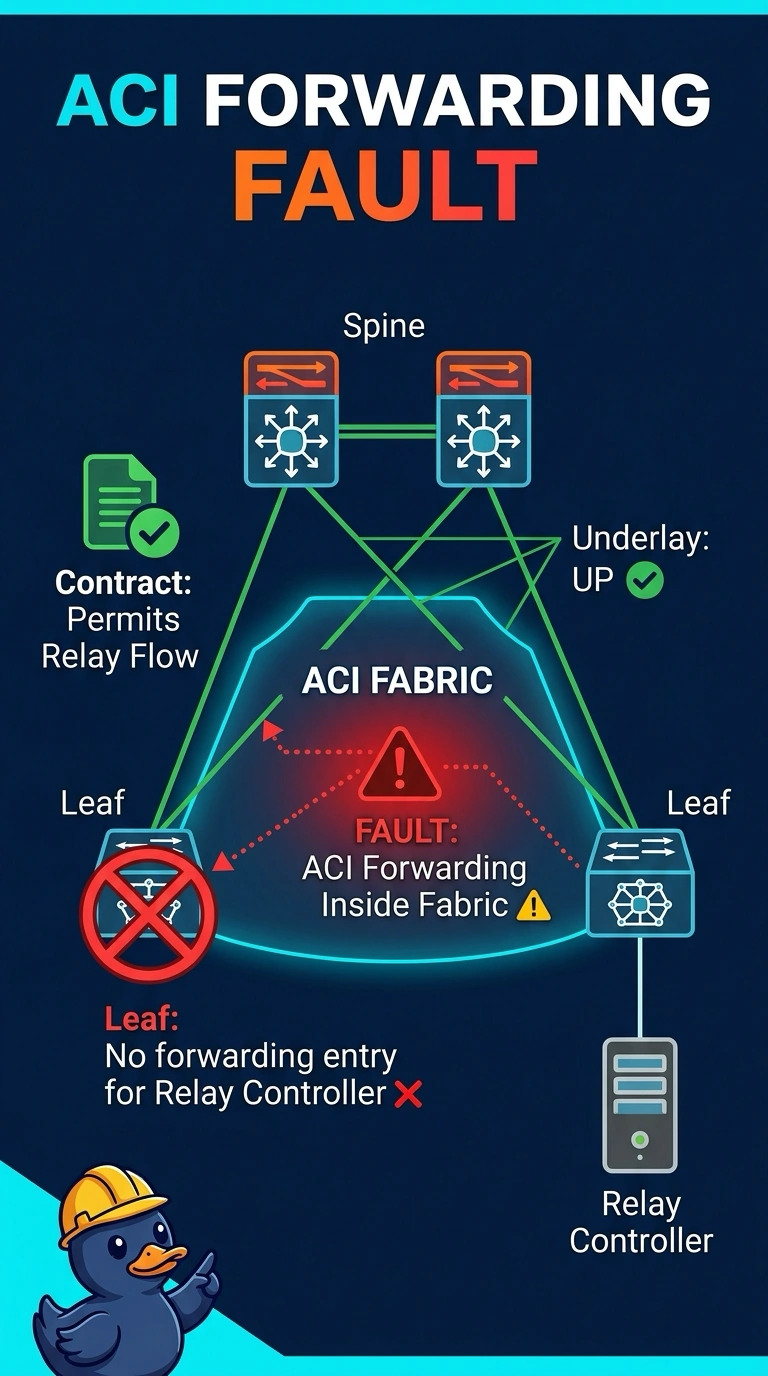
A power-grid control center runs an ACI fabric. A contract already permits the relay flow, the underlay is up, and the leaf has no forwarding entry for the relay controller. Where is the fault?
Select an answer to reveal the explanation.
Short Explanation
A missing name badge at the door is like an endpoint the leaf never programmed. You look at ACI forwarding inside this fabric, where the contract and the underlay are already healthy. An EVPN VXLAN overlay, a pseudowire, and EVPN over a segment-routed core are not the path between these leaves.
Full Explanation
ACI forwarding programs endpoints on the leaf. Here the contract already permits the relay flow and the underlay is up, but the leaf has no forwarding entry for the relay controller. That is an ACI forwarding fault inside this fabric. An EVPN VXLAN overlay is not how these leaves carry the flow. A pseudowire is not the circuit in the path. EVPN over a segment-routed MPLS core is not present between these leaves. ACI forwarding inside that fabric, where the leaf has not programmed the relay controller is the design that meets this requirement. An EVPN VXLAN overlay between data centers that this control center does not use is the wrong fit because this control center does not extend the relay controller across an EVPN VXLAN overlay between data centers. A pseudowire emulating one point-to-point circuit this ACI fabric does not carry is the wrong fit because the missing entry is inside the ACI fabric, not on a point-to-point circuit a pseudowire would emulate. EVPN over a segment-routed MPLS core that is not present between these leaves is the wrong fit because no segment-routed MPLS core sits between these leaves, so that encapsulation is not the broken path. Exam caveat: A contract that already permits the flow does not prove the leaf programmed the endpoint, so the drop can still be ACI forwarding inside the fabric. Operational check: Verify endpoint learning at the owning leaf and the spine COOP database. A leaf can forward through the spine proxy for a remote endpoint without a local entry; confirm the actual lookup and drop with a trace.