
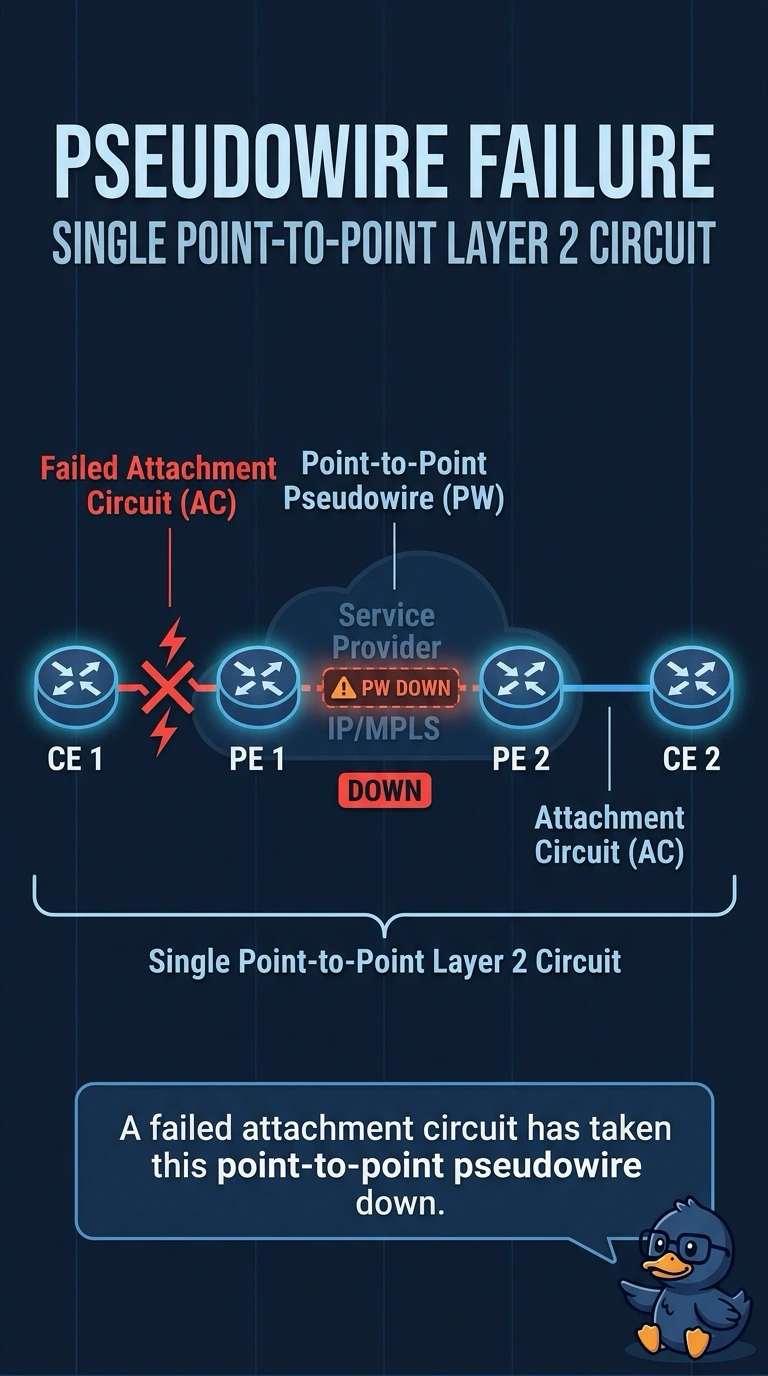
A stock exchange keeps a single point-to-point Layer 2 circuit between two ports. One attachment circuit is down, and the path contains no EVPN, no VXLAN, and no ACI fabric. Which fault matches the path?
Select an answer to reveal the explanation.
Short Explanation
A pseudowire is like a private string between two tin cans, and one can just came off the string. You repair the attachment circuit on that point-to-point emulation. An EVPN VXLAN overlay, an EVPN service on a segment-routed core, and an ACI policy denial each belong to a path this circuit does not use.
Full Explanation
A pseudowire is a point-to-point emulation tied to attachment circuits at each end. The exchange circuit is exactly that: one Layer 2 service between two ports, and one attachment circuit is down. Nothing in the path is EVPN, VXLAN, a segment-routed core, or ACI. Diagnosing an overlay or a policy fabric would chase encapsulations that are not carrying this circuit. A failed attachment circuit has taken this point-to-point pseudowire down is the design that meets this requirement. An EVPN VXLAN overlay fault stretching two separate data-center fabrics is the wrong fit because EVPN with VXLAN extends Layer 2 across a data-center fabric, and this circuit is a single point-to-point emulation with no VXLAN. An EVPN service that is failing on a segment-routed MPLS core label stack is the wrong fit because there is no EVPN control plane and no segment-routed core in this path, so a label stack is not what failed. An ACI policy denial between the endpoints that sit inside one policy fabric is the wrong fit because an ACI denial is a policy or forwarding fault inside an ACI fabric, and this path has no ACI fabric. Exam caveat: A pseudowire fault stays with that point-to-point service, and a similar symptom inside an EVPN or ACI path would point at that other encapsulation instead. Operational check: Confirm the attachment circuit on the failed end is down and that the service record is a pseudowire between the two ports, with no EVPN or ACI hop in the path.