
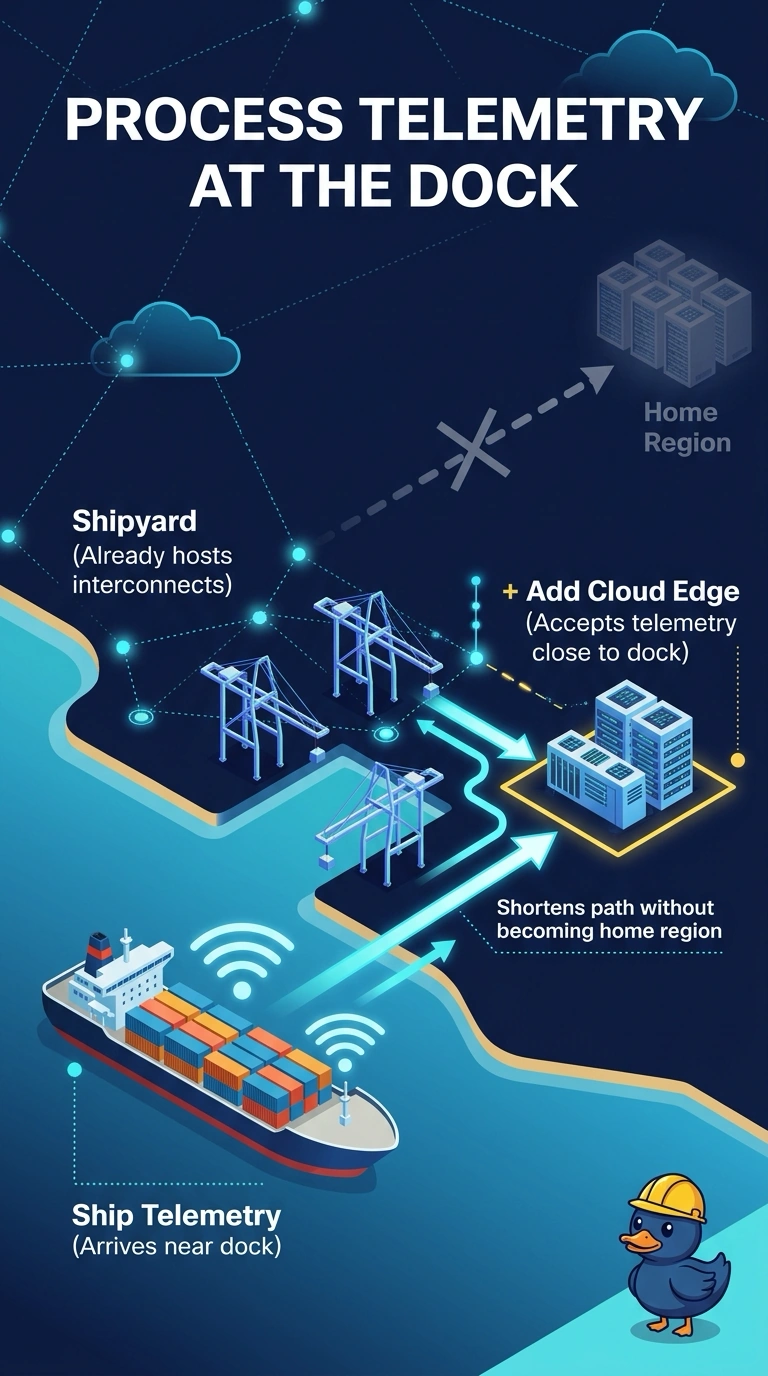
Ship telemetry hairpins through a distant cloud region before anyone can process it. A carrier-neutral shipyard already hosts interconnects. Which addition shortens that path without becoming the home region?
Select an answer to reveal the explanation.
Short Explanation
You add that facility at the shipyard so telemetry does not hairpin, not by just renaming the building or cabling another carrier. Place the required application or processing capacity at a supported nearby edge location and verify the end-to-end path. A local cross-connect alone can still carry traffic to the distant region.
Full Explanation
A cloud-edge facility is a nearby cloud entry that shortens the path and is not the home region. Ship telemetry hairpins through a distant region. Placing a cloud-edge facility at the carrier-neutral shipyard lets that telemetry enter close to the dock for this requirement. Place the required application or processing capacity at a supported nearby edge location and verify the end-to-end path. A local cross-connect alone can still carry traffic to the distant region. Calling the carrier-neutral shipyard building itself the home cloud region is the wrong fit because the shipyard building is a meet point for interconnects and does not become the home cloud region. A cross-connect to a second carrier cage when the telemetry needs a cloud entry is the wrong fit because a cross-connect to another carrier hands traffic to that carrier and does not open a nearby cloud entry. A private interconnect from the shipyard into the same distant region already in use is the wrong fit because a private interconnect into the same distant region keeps the hairpin this design is trying to remove. Exam caveat: The cloud-edge facility stays attached to the home region, so the shipyard building is not registered as that region. Operational check: Confirm ship telemetry is accepted at the shipyard cloud-edge facility and that the home region record still names the distant region, not the shipyard.