
Two retail data centers advertise MAC addresses with EVPN, the core under that EVPN is segment routing with MPLS, and forwarding fails because the core label stack is wrong while the EVPN routes still exist at the edges. Which path is at fault?
Select an answer to reveal the explanation.
Short Explanation
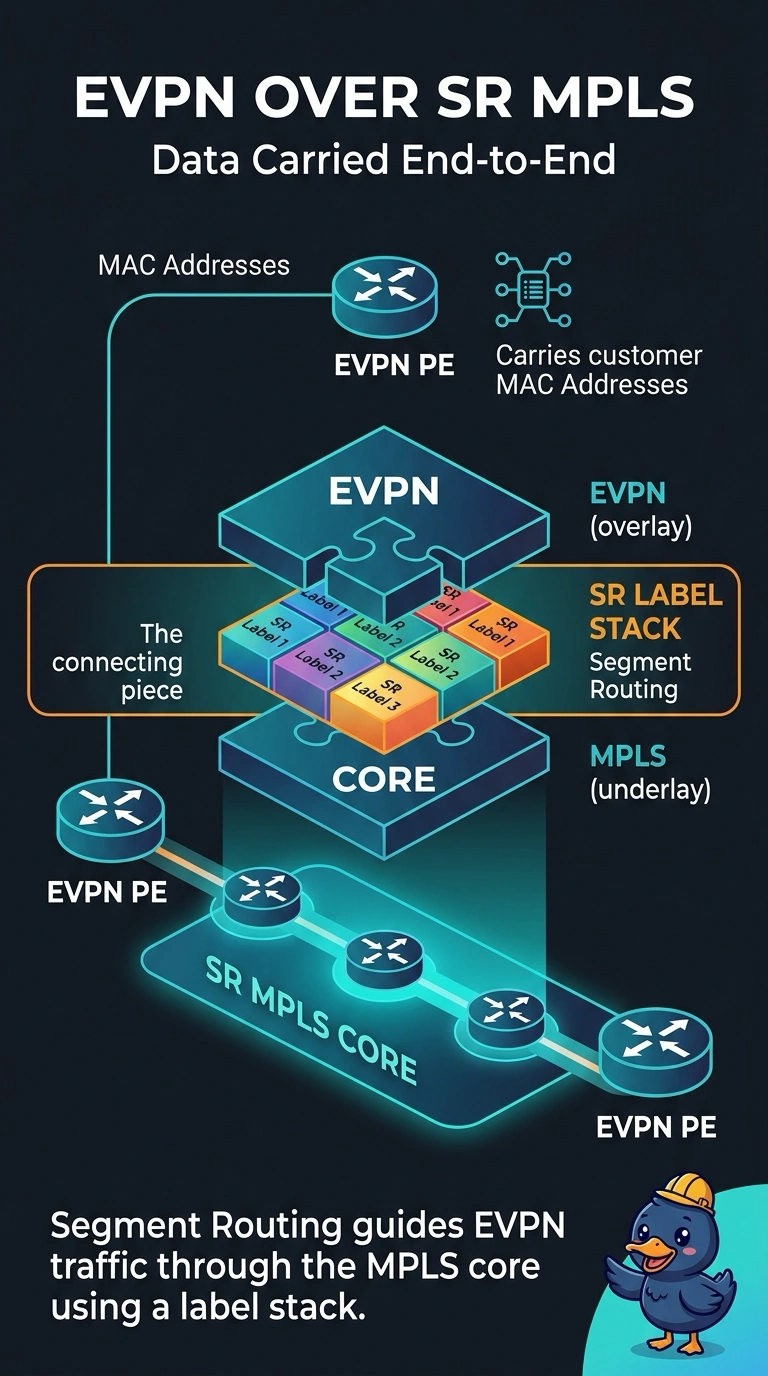
The passenger list is fine, but the train tickets on the core are printed wrong, so the cars never leave the yard. You fix the EVPN service where it rides the segment-routed MPLS label stack. A VXLAN underlay, an ACI contract, and a pseudowire each describe an encapsulation this path is not using.
Full Explanation
Match the fault to the encapsulation that is actually in the path. MP-BGP advertises EVPN reachability. SR-MPLS transports the service’s data traffic between PEs. Inspect the transport and service labels when the routes are present but forwarding fails. That separation explains why the edges still have EVPN routes while forwarding fails on a wrong label stack in the segment-routed core. EVPN carried over the segment-routing MPLS core, where the label stack is the broken piece is the design that meets this requirement. EVPN with VXLAN, as if the data-center underlay were the encapsulation that failed is the wrong fit because VXLAN is an alternative overlay encapsulation over an IP underlay, not the transport under this EVPN, so chasing a VXLAN underlay ignores the label stack. An ACI contract denial inside a single policy fabric between the two sites is the wrong fit because an ACI contract is a policy fault inside an ACI fabric, while this path is an EVPN control plane over a segment-routed core. A point-to-point pseudowire whose attachment circuit is the failed hop is the wrong fit because a pseudowire is a point-to-point emulation, not an EVPN advertisement riding a segment-routed MPLS core. Exam caveat: a healthy EVPN route at the edge does not prove the core labels are intact.