
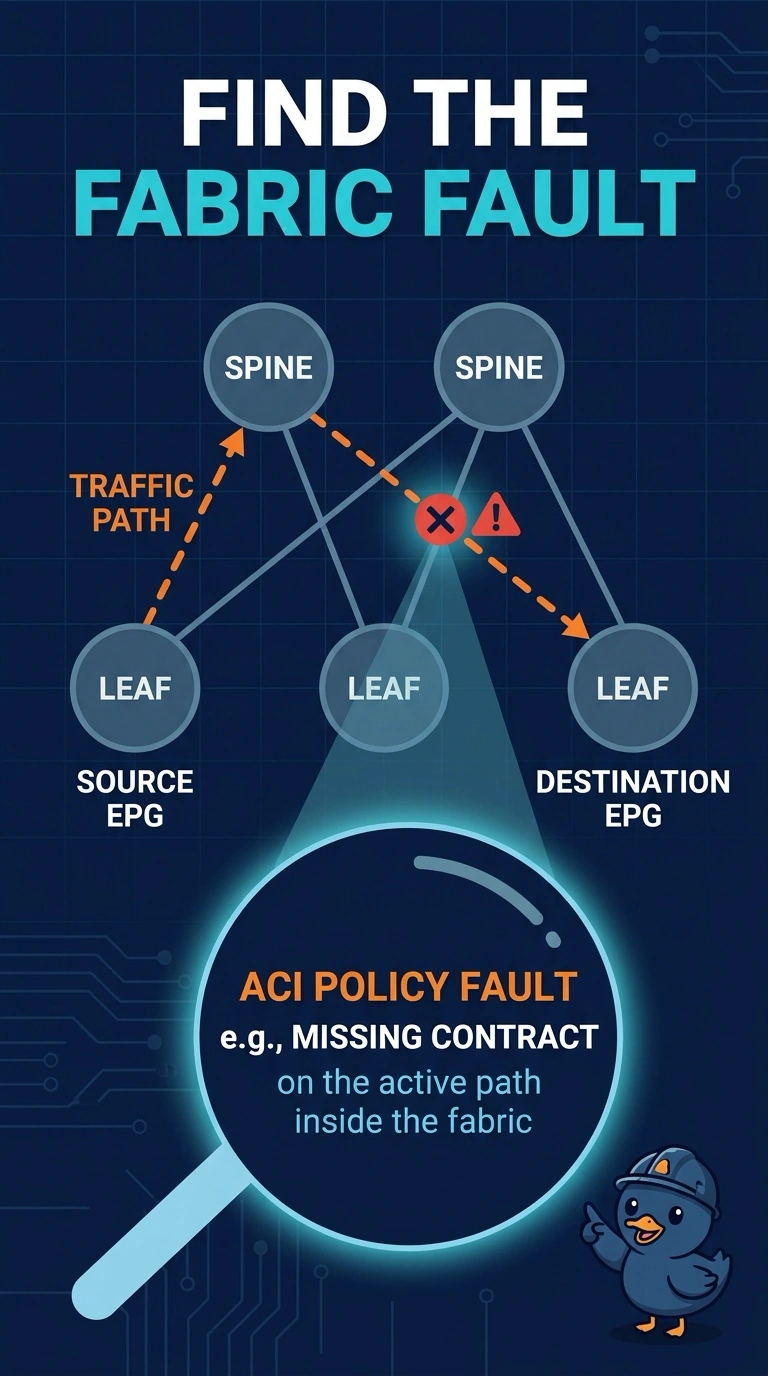
Inside one ACI fabric, two endpoint groups have learned each other's endpoints, but application traffic between them is dropped. No pseudowire and no segment-routed core are on this path. The EPGs are in a policy-enforcing VRF, and no contract allows the required flow between them. Which fault fits?
Select an answer to reveal the explanation.
Short Explanation
A badge reader that knows your face but still will not open the door is a rule problem, not a missing highway. You fix the ACI policy between the endpoint groups, because the endpoints are already learned and the other encapsulations are absent. A pseudowire, EVPN on a segment-routed core, and a non-ACI VXLAN fabric are not this path.
Full Explanation
ACI is a policy fabric. Endpoints that are learned while application traffic is still dropped point at policy or forwarding inside that fabric, commonly a missing contract. A pseudowire is a point-to-point emulation and is not this path. EVPN over segment routing and MPLS would be a core concern only if that core carried the service. A separate VXLAN fabric is not the fabric in front of these groups. An ACI policy fault, such as a missing contract, inside the fabric that is actually on the path is the design that meets this requirement. A failed pseudowire between the endpoint groups, as if they were joined by point-to-point emulation is the wrong fit because a pseudowire is a point-to-point emulation, and these endpoint groups sit in an ACI fabric with no pseudowire. An EVPN control-plane fault on a segment-routed MPLS core that this ACI path does not use is the wrong fit because EVPN over a segment-routed core is a different encapsulation, and that core is not on this ACI path. A VXLAN overlay fault on a non-ACI fabric that is not forwarding this application traffic is the wrong fit because a non-ACI VXLAN fabric is a different overlay, and the dropped traffic is inside the ACI policy fabric. Exam caveat: If the failed path really is a pseudowire or an EVPN core, debug that encapsulation instead of hunting for an ACI contract on a path that is not ACI. Operational check: Verify the relevant zoning rules and confirm the intended traffic is allowed after applying the correct contract.