
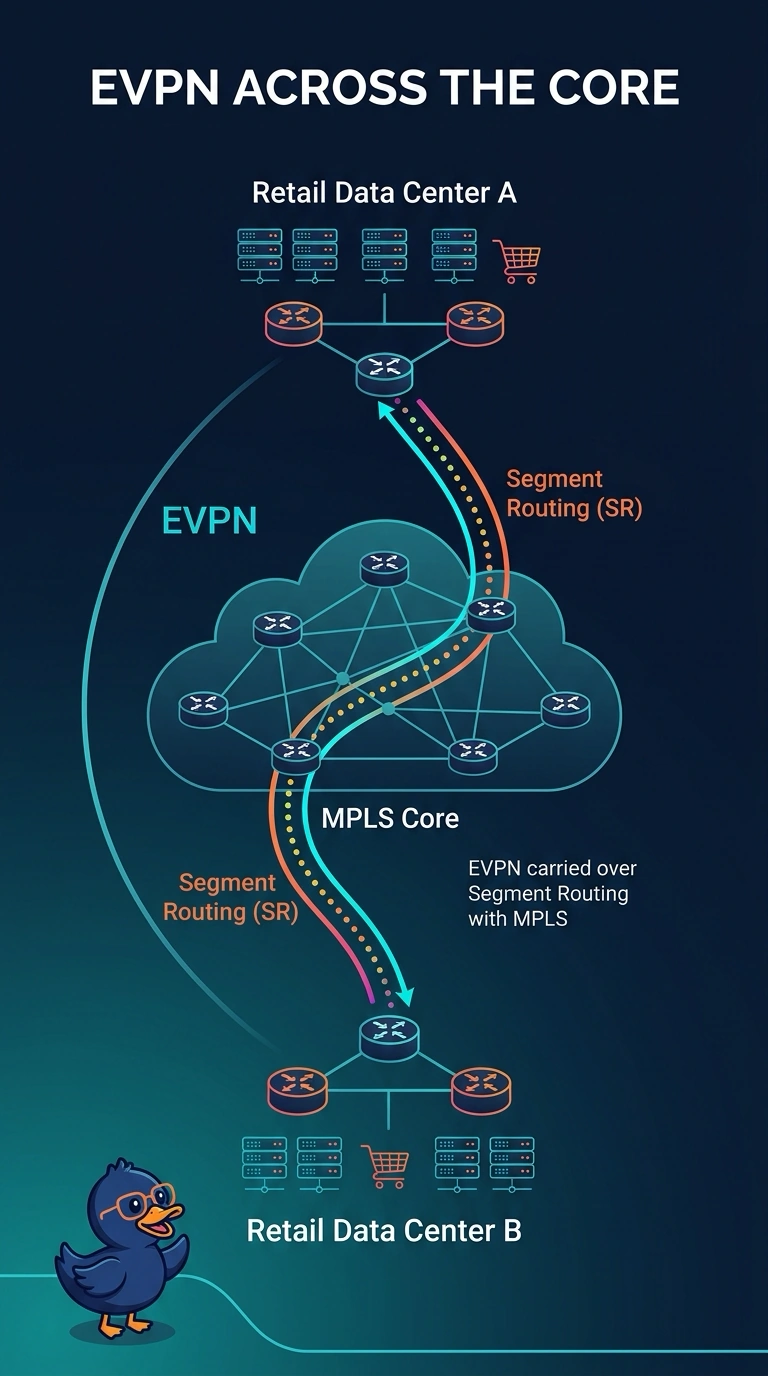
Two retail data centers extend EVPN across a segment-routed core, and the failure is on that core rather than inside either fabric. Which encapsulation is in the failing path?
Select an answer to reveal the explanation.
Short Explanation
The city streets are open and the bridge between towns is the part that failed. You look at EVPN over segment routing with MPLS, because that is the core actually carrying the service. Local VXLAN, an ACI fault, and a pseudowire describe a different place or a different encapsulation than the one in this path.
Full Explanation
MP-BGP advertises EVPN reachability. SR-MPLS transports the service’s data traffic between PEs. Inspect the transport and service labels when the routes are present but forwarding fails. VXLAN is an alternative overlay encapsulation over an IP underlay. EVPN carried over segment routing with MPLS between the two data centers is the design that meets this requirement because that MPLS transport is the failing core path. EVPN with VXLAN that stays confined to the fabric inside a single data center is the wrong fit because that VXLAN path lives inside one fabric, and the failure named here is the core between the data centers. An ACI policy or forwarding fault in a fabric that is not on this path is the wrong fit because an ACI fault belongs to ACI policy or forwarding, and this failing path is not an ACI fabric. A point-to-point pseudowire used in place of the multipoint EVPN service is the wrong fit because a pseudowire emulates one point-to-point circuit, and this service is multipoint EVPN across the core. Exam caveat: Match the fault to the encapsulation that is actually in the path. A healthy fabric overlay does not explain a break in the segment-routed core between sites. Operational check: On the core, confirm the EVPN routes are present in MP-BGP and then check the transport and service labels to follow the SR-MPLS forwarding between PEs.