
Inside one leaf-spine fabric, hosts on different racks lose Layer 2 reachability. The fabric extends those segments with EVPN and VXLAN, and a separate branch pseudowire is up. Where is the fault?
Select an answer to reveal the explanation.
Short Explanation
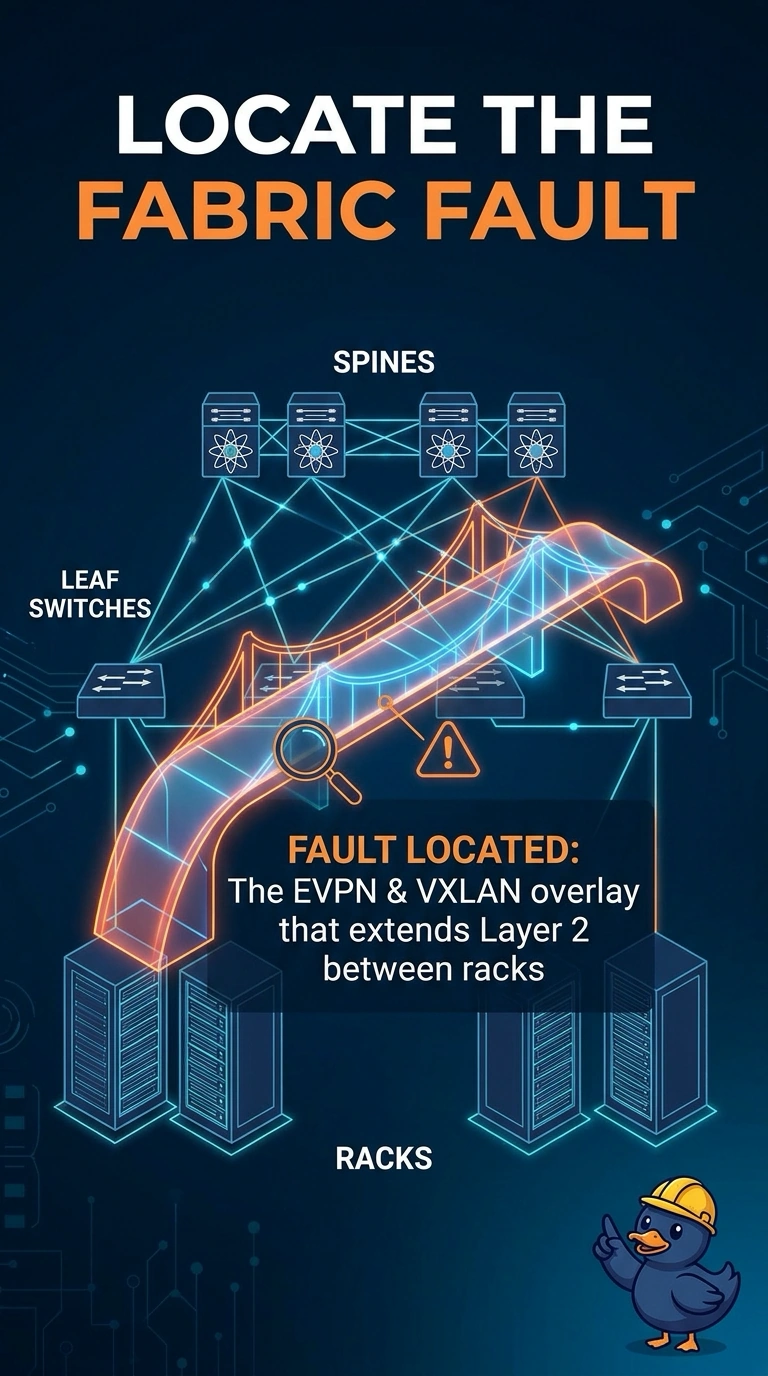
When the campus map overlay is torn, you do not blame a footbridge that is still standing. You look at the EVPN and VXLAN overlay that extends Layer 2 across this leaf-spine fabric. A pseudowire, EVPN over a segment-routed core, and an ACI policy fabric are not the encapsulation in this path.
Full Explanation
EVPN with VXLAN is the overlay that extends Layer 2 across this leaf-spine fabric, and that is the path between the racks that just failed. A pseudowire is a point-to-point emulation, and the branch pseudowire is still up. EVPN over segment routing or MPLS would be the control plane across a segment-routed core, which this fabric is not using. An ACI fault is policy or forwarding inside an ACI fabric this site does not run. The EVPN and VXLAN overlay that extends Layer 2 between racks in this fabric is the design that meets this requirement. The branch pseudowire, a point-to-point circuit that is still up and is outside this fabric is the wrong fit because that pseudowire is up and emulates a branch circuit, so it is not the overlay between racks inside this fabric. EVPN over a segment-routed MPLS core that this leaf-spine fabric does not use for the segment is the wrong fit because this leaf-spine fabric extends the segment with VXLAN, and it is not an EVPN control plane over a segment-routed core. An ACI policy or forwarding entry in a policy fabric this site does not operate is the wrong fit because an ACI fault belongs inside an ACI policy fabric, and this site extends Layer 2 with EVPN and VXLAN instead. Exam caveat: Name the encapsulation that is in the failed path. A healthy pseudowire, an unused segment-routed core, and an absent ACI fabric do not explain a broken EVPN and VXLAN overlay. Operational check: On the leaf switches, confirm EVPN routes and VXLAN tunnels for the affected segment are the ones that failed, while the branch pseudowire stays up.