
EVPN routes for a data-center interconnect are present, but the segment-routing transport that should carry them between the sites is down. Which fault is that?
Select an answer to reveal the explanation.
Short Explanation
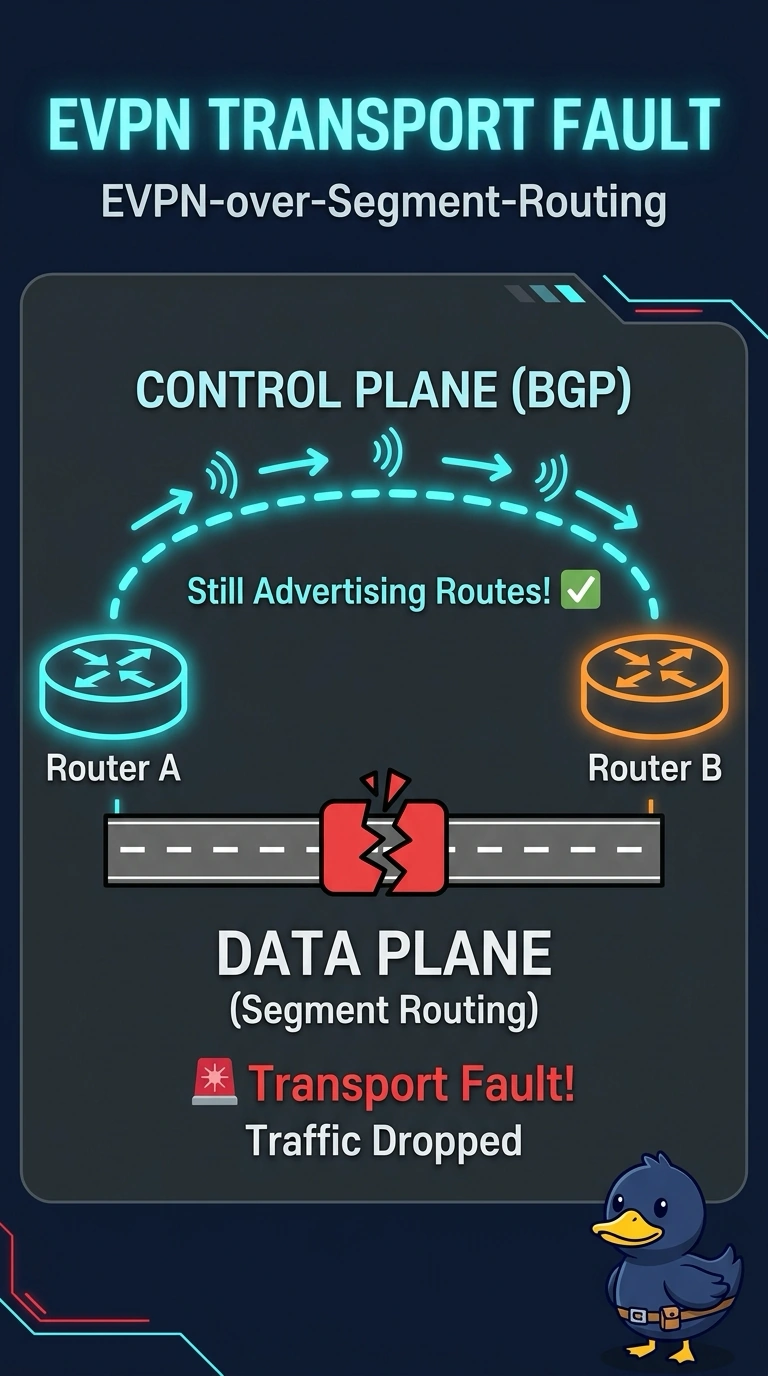
You can think of it like a timetable being right while the tracks between stations are closed. This is an EVPN-over-segment-routing transport fault: routes are present, but the segment-routed path is down. A VXLAN-only overlay fault, an ACI policy or forwarding fault, and a pseudowire fault describe different paths or technologies.
Full Explanation
MP-BGP can advertise EVPN reachability while SR-MPLS transports the service’s data traffic between PEs. Because EVPN routes are present but the segment-routing transport is down, the fault is an EVPN-over-segment-routing transport fault under a control plane that is still advertising routes; the issue is not a missing EVPN advertisement. A VXLAN-only overlay fault on a data-center fabric that is not the encapsulation between these sites does not fit: VXLAN is an alternative overlay encapsulation over an IP underlay, whereas this path carries EVPN over SR-MPLS. An ACI policy or forwarding fault inside an ACI fabric that this interconnect path does not cross does not fit because it concerns policy or forwarding within a fabric the inter-site path does not traverse. A pseudowire fault on a point-to-point emulation that is not the join between these two sites does not fit because a pseudowire provides point-to-point emulation, while this interconnect is EVPN over segment routing. An exam caveat is that present EVPN routes confirm control-plane reachability, not successful data-plane forwarding. As a practical check, inspect the transport and service labels when routes are present but forwarding fails.