
A pharmacy chain reaches its public cloud across the internet and must encrypt that traffic on a path that is not private. Which design adds the encryption?
Select an answer to reveal the explanation.
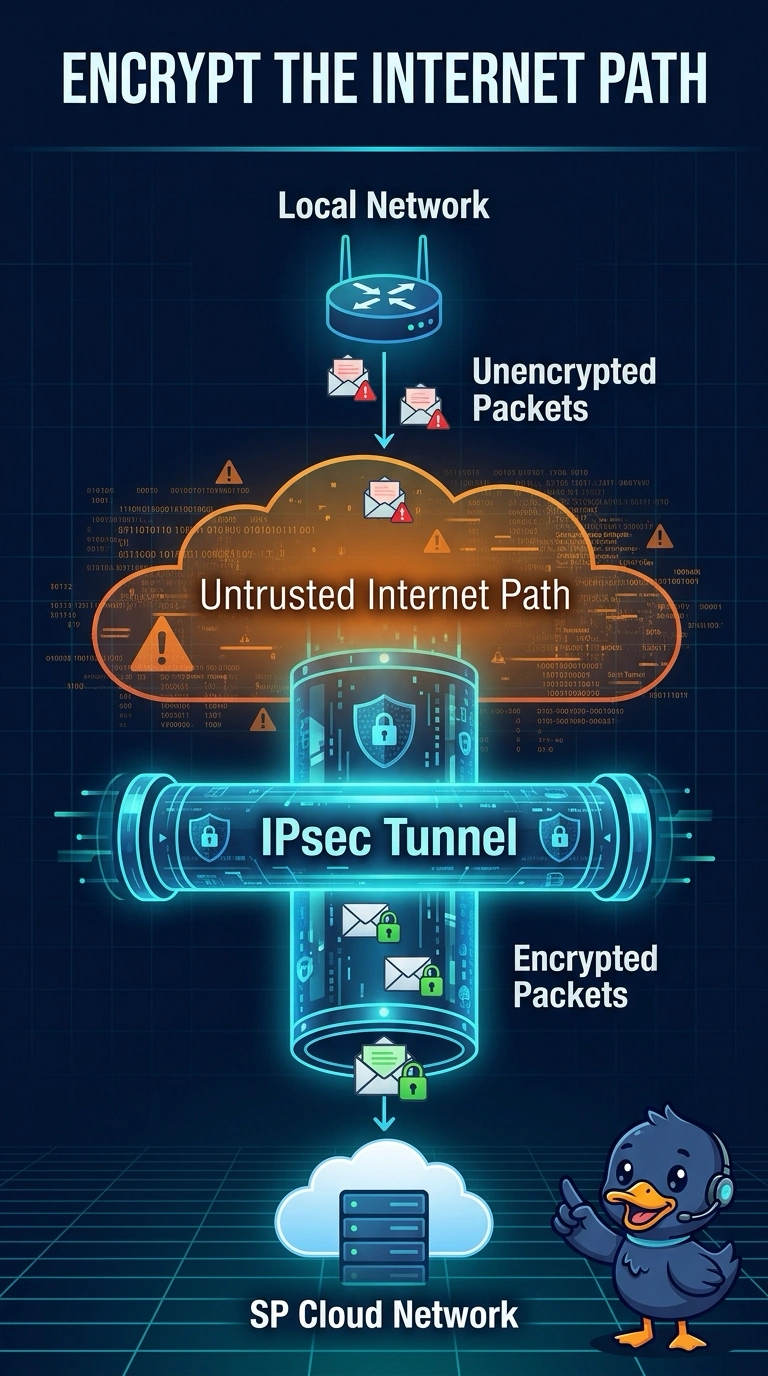
Short Explanation
A locked box hides the contents, while a painted label on the outside does not. You encrypt the pharmacy traffic with IPsec because the internet path is not private. A private interconnect, MPLS labels, and GRE encapsulation do not provide that encryption.
Full Explanation
Encryption is a property of a protocol such as IPsec, not of the path name. A private interconnect is a dedicated path into the cloud and does not encrypt traffic by itself. MPLS steers packets with labels across the provider core and is not a cipher. GRE adds a tunnel header and leaves the payload readable. When the pharmacy path is the public internet, the design that hides the packets is IPsec. An IPsec tunnel that encrypts the packets on this untrusted internet path is the design that meets this requirement. A private interconnect ordered in place of an encryption protocol on this path is the wrong fit because a dedicated private path is not a cipher, so the packets stay readable unless a separate protocol encrypts them. MPLS transport across the provider core in place of an encryption protocol is the wrong fit because labels steer packets across the provider core and do not encrypt the payload on an untrusted internet path. GRE encapsulation of the packets in place of an encryption protocol on this path is the wrong fit because the tunnel header only encapsulates packets and leaves the payload readable to anyone who can see the path. Exam caveat: Order IPsec when you must encrypt an untrusted path. A private interconnect does not encrypt by itself, and MPLS or GRE only steers or encapsulates. Operational check: On the pharmacy edge, confirm IPsec protections are up toward the cloud and that packets on the internet path leave encrypted rather than in the clear.