
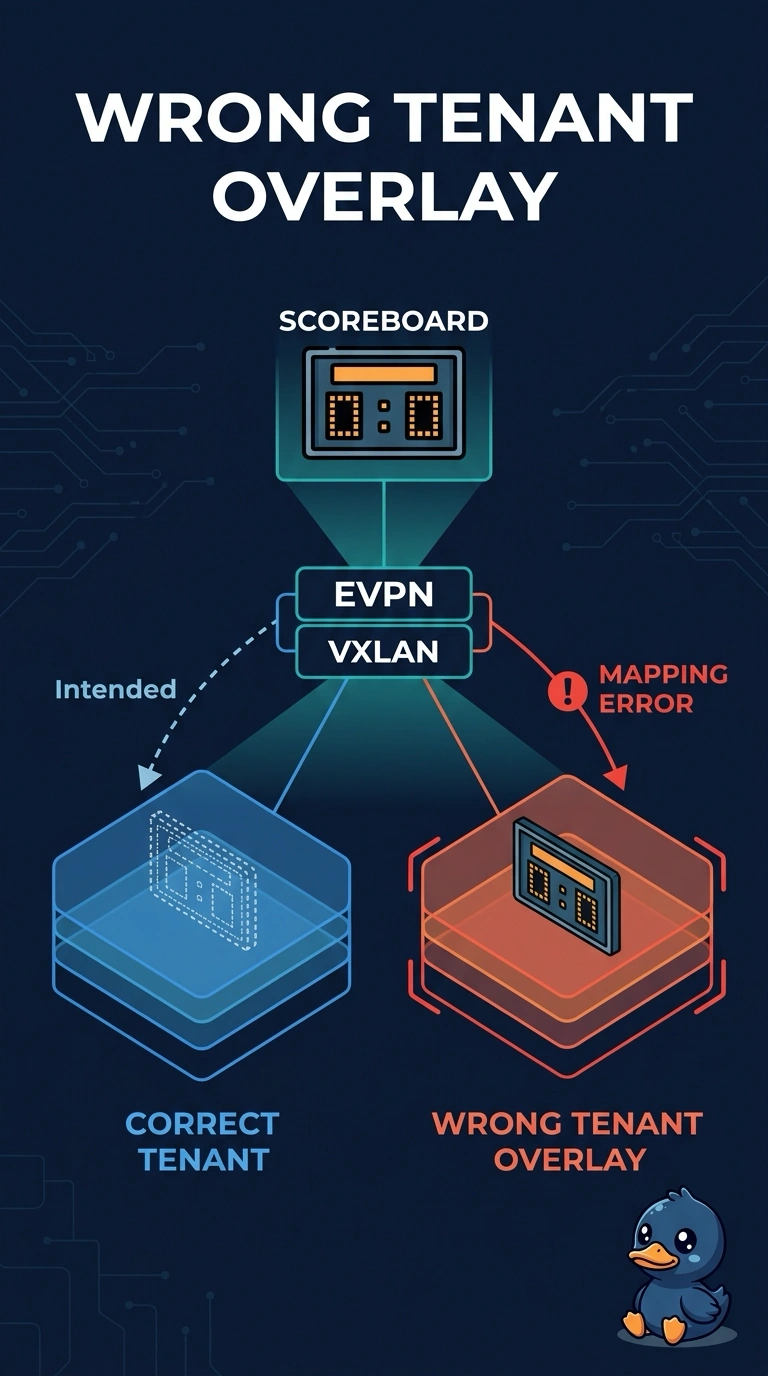
In a sports arena, leaf-to-leaf pings succeed and the VXLAN tunnels are up, but a scoreboard shows up in the wrong tenant. The fabric extends tenants with EVPN and VXLAN. Where is the fault?
Select an answer to reveal the explanation.
Short Explanation
The hallway is open, and the name tag was hung on the wrong office door. You fix the EVPN and VXLAN mapping that put the scoreboard in the wrong tenant. The underlay, a pseudowire, and an ACI contract are not the mapping this arena is using.
Full Explanation
EVPN with VXLAN is the overlay that places a host in a tenant. Leaf-to-leaf pings succeed and the VXLAN tunnels are up, so the underlay and the tunnels are alive. The scoreboard appears in the wrong tenant, which means the EVPN and VXLAN mapping put it in the wrong overlay. A pseudowire is not this fabric, and an ACI contract is a different design than the one the arena is using. The EVPN and VXLAN mapping that placed the scoreboard into the wrong tenant overlay is the design that meets this requirement. The underlay between the leaves that still forwards pings and is not the tenant mapping is the wrong fit because the underlay still forwards leaf-to-leaf pings, so it is not the mapping that put the scoreboard in the wrong tenant. A pseudowire between remote sites that this single-fabric scoreboard path does not use is the wrong fit because a pseudowire is a point-to-point emulation between sites, and this scoreboard stays inside one EVPN fabric. An ACI contract in a policy fabric that is not the design carrying this scoreboard is the wrong fit because an ACI contract belongs to a policy fabric, and this arena extends tenants with EVPN and VXLAN instead. Basic leaf-to-leaf pings confirm IP reachability for those probes. Verify the scoreboard access-port VLAN and its mapping to the intended bridge domain and VNI, then check the EVPN route import.