
A bank wants a dedicated path into its cloud that stays off the public internet, and it does not need an encryption tunnel to make that path private. Which connection matches?
Select an answer to reveal the explanation.
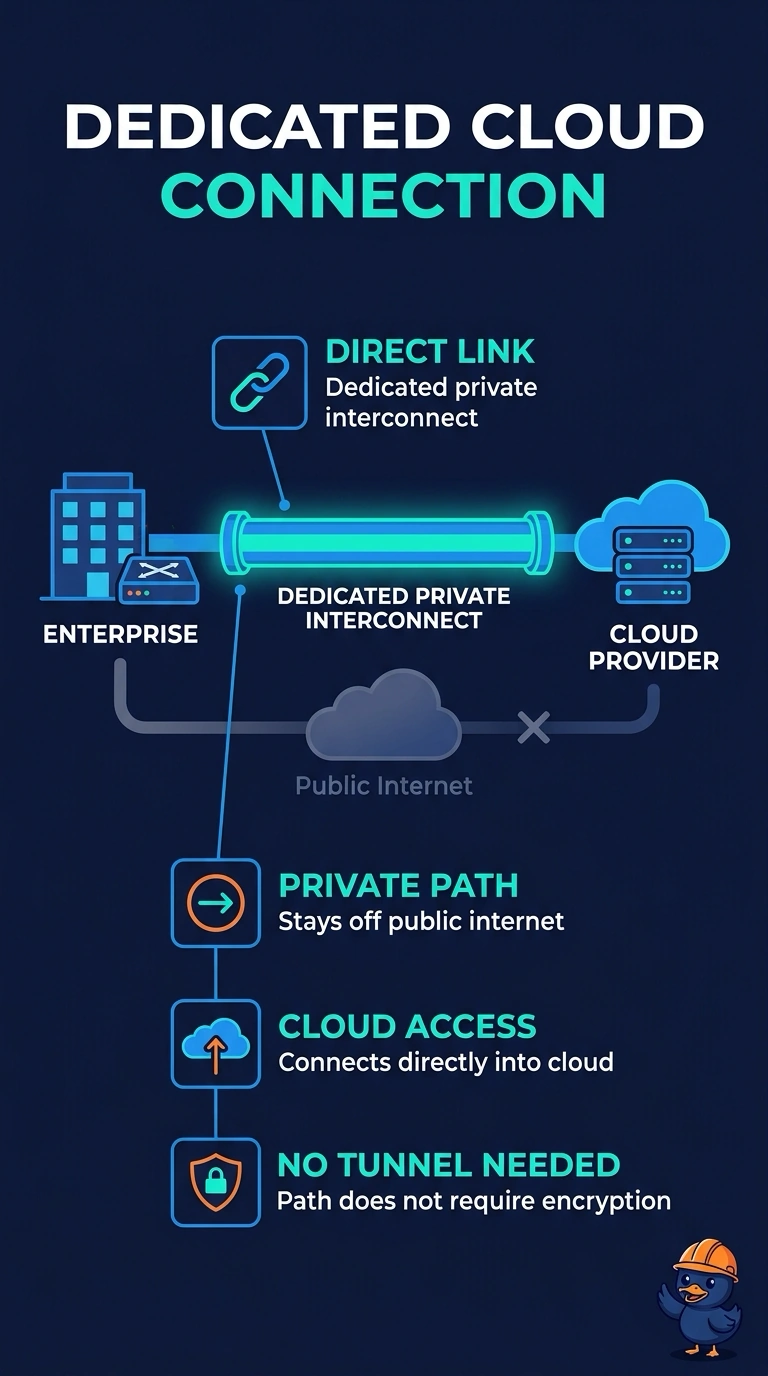
Short Explanation
You’re looking for a direct private interconnect: a dedicated path into the cloud that stays off the public internet. IPsec over the internet encrypts a public path, while MPLS transport labels and segment routing do not provide that dedicated cloud entry.
Full Explanation
A direct private interconnect gives the bank a dedicated path into the cloud without using the public internet. Its privacy comes from the dedicated path, not from an IPsec encryption tunnel, so it matches the stated requirement. IPsec over the public internet creates an encrypted tunnel across a public path; encryption can protect traffic, but it does not make that path a dedicated private connection. MPLS uses provider transport labels to forward traffic, but those labels do not themselves create the dedicated entry from the bank into the cloud. Segment routing steers traffic through a provider core, but traffic steering alone does not provide a private cloud entry. Exam caveat: If policy requires network-layer confidentiality, use IPsec ESP with encryption even over a private circuit; a dedicated attachment does not guarantee end-to-end encryption. Practical check: Confirm that the bank’s service is a dedicated private interconnect into the cloud and that its working path does not hairpin across the public internet.