
A pharmacy chain reaches its cloud across the public internet and must encrypt that traffic on a path that is not private. Which addition supplies the missing protection?
Select an answer to reveal the explanation.
Short Explanation
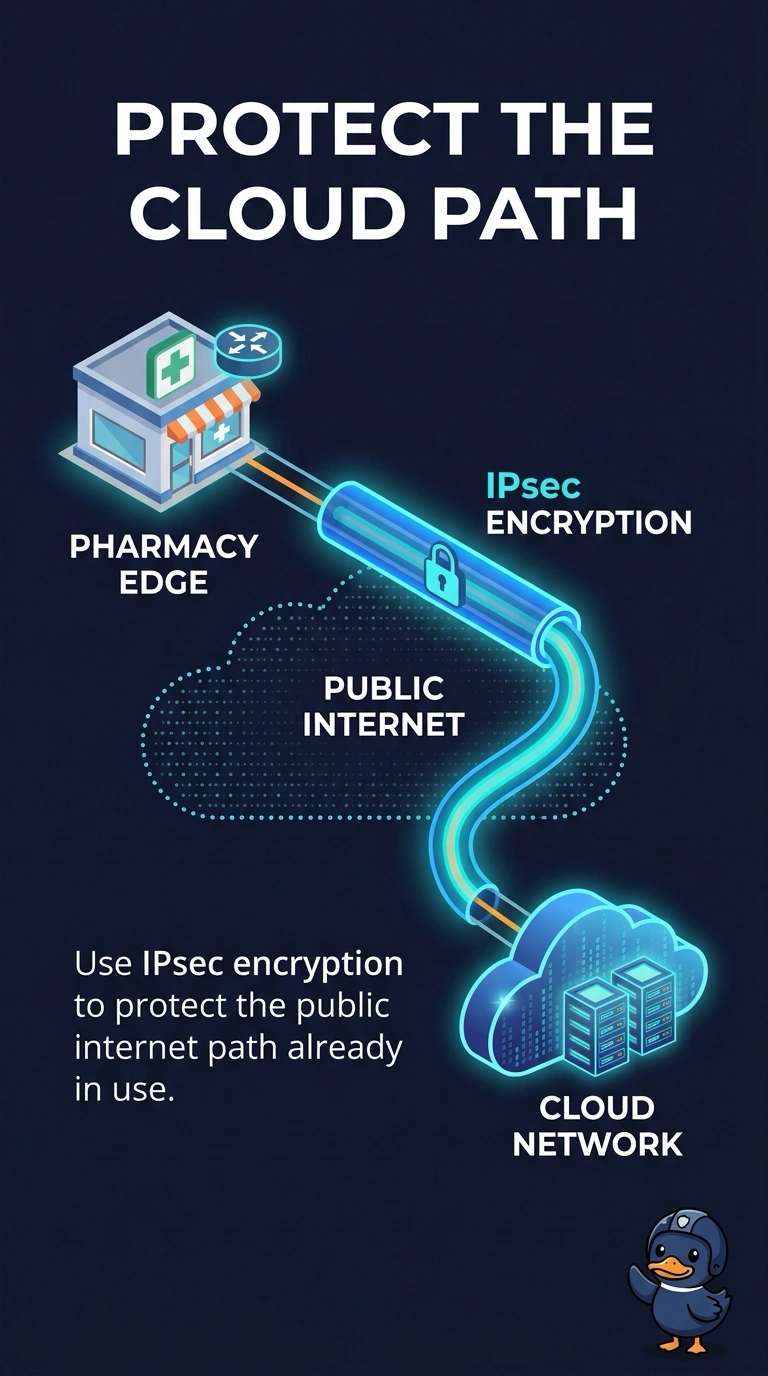
You can think of the public internet as a road that is not private, so you need encryption on the path you already use. Add IPsec between the pharmacy edge and the cloud; a dedicated private interconnect, MPLS transport, or segment routing does not encrypt this internet path.
Full Explanation
IPsec encryption between the pharmacy edge and the cloud supplies the missing protection because the pharmacy’s traffic travels over the public internet, a path that is not private. It encrypts traffic on the internet path already in use, rather than requiring a different path. A dedicated private interconnect would replace the internet path with a dedicated path, but it does not encrypt the existing internet traffic. MPLS transport across a provider core labels packets; those labels do not encrypt this internet path. Segment routing steers packets across the core, but steering does not encrypt them on this path. The requirement is specifically to protect traffic on the public internet, so choices that change or steer the path do not provide the missing encryption. Exam caveat: Reaching the cloud through a private interconnect does not make that interconnect IPsec, and using MPLS does not make traffic encrypted merely because it traverses a provider core. Practical check: Confirm that internet sessions between the pharmacy edge and the cloud are protected by IPsec, rather than relying on a dedicated private interconnect, MPLS packet labels, or segment routing.