
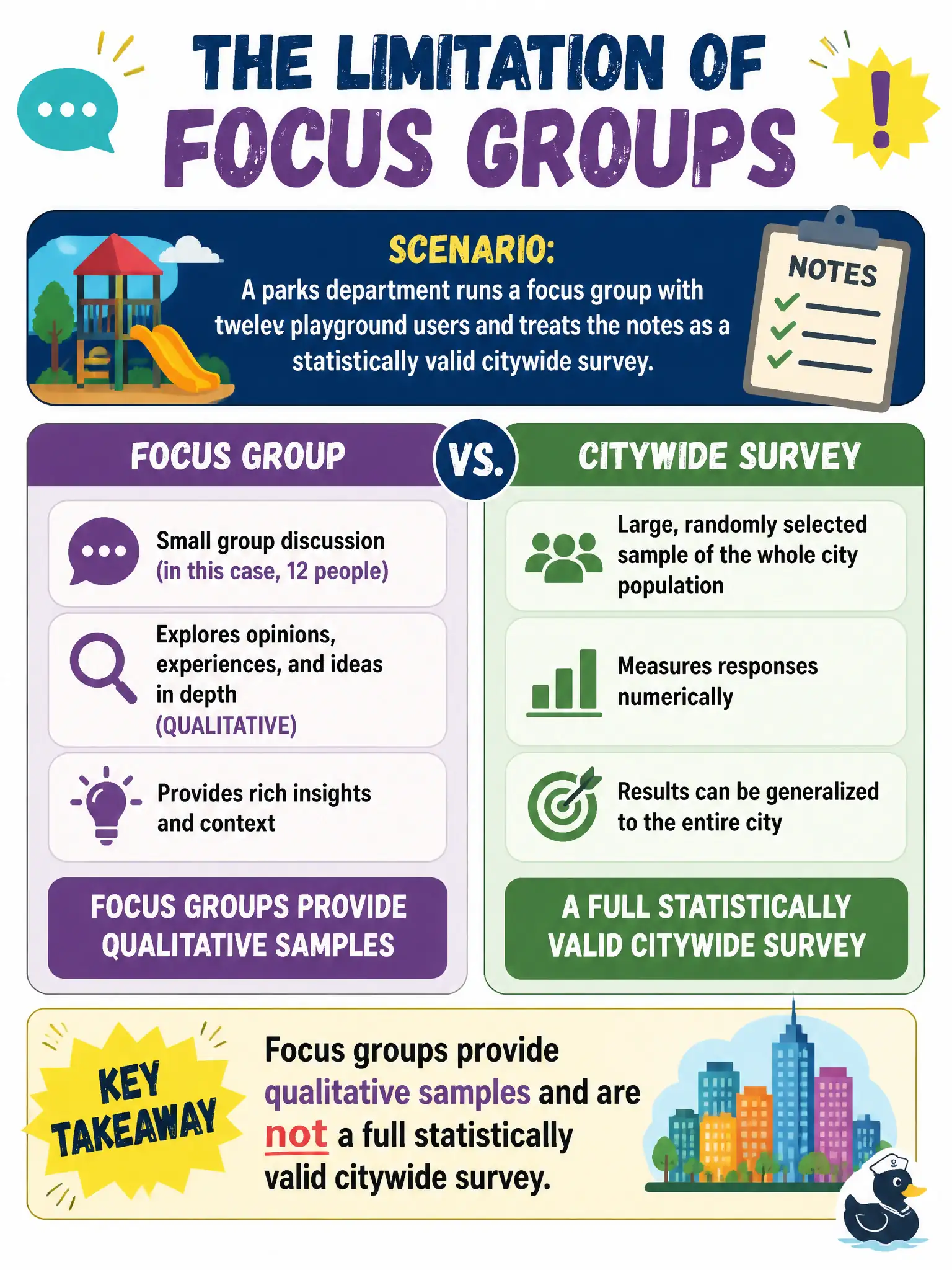
A parks department runs a focus group with twelve playground users and treats the notes as a statistically valid citywide survey. What limitation of focus groups does this miss?
Select an answer to reveal the explanation.
Short Explanation
Twelve people in a room give rich stories, not a citywide poll with fancy margins of error. Focus groups are qualitative samples—great for depth, weak as a census. Don’t dress them up as a full survey.
Full Explanation
Treating notes from twelve playground users as a statistically valid citywide survey misses a core limitation of focus groups: they provide qualitative samples, not census-level quantitative proof. Parks departments gain rich insight into perceptions and design reactions, but sample size and method do not support citywide statistical generalization. Overclaiming validity risks poor civic decisions dressed as “research.”
Focus groups do not always produce census-level quantitative margins of error; that claim invents a strength they lack. They are not restricted to use only after project closeout. They also do not replace all other stakeholder analysis methods such as registers, surveys, or interviews at scale.
Exam caveat: CAPM associates should select elicitation techniques with eyes open to bias and scope. Qualitative richness and statistical representativeness are different claims.
Operational check: label focus-group findings as qualitative themes, use them to refine designs or hypotheses, and commission a broader survey or additional methods if the city needs statistically defensible citywide estimates. Mixing method claims also confuses elected officials who may treat “focus group says” as polling truth. Keep methods honest so parks investments rest on the right evidence class for the decision being made.