
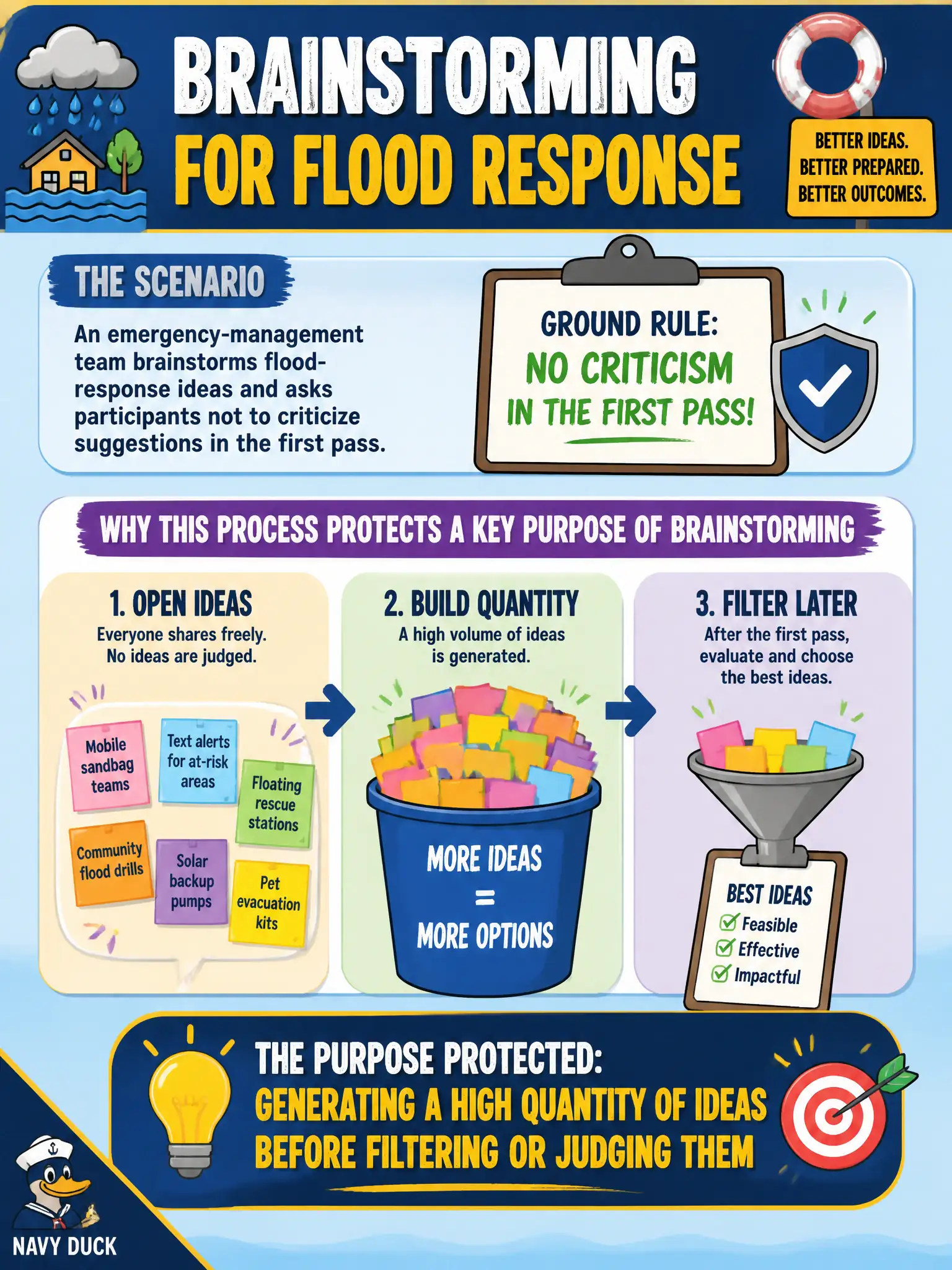
An emergency-management team brainstorms flood-response ideas and asks participants not to criticize suggestions in the first pass. What purpose of brainstorming does this protect?
Select an answer to reveal the explanation.
Short Explanation
Brainstorming’s first job is a big pile of ideas—judgment waits at the door. If you shoot down every thought in round one, the pile stays tiny. Quantity first, then filter.
Full Explanation
An emergency-management brainstorm on flood-response ideas that asks participants not to criticize suggestions in the first pass protects the core purpose of brainstorming: generating a high quantity of ideas before filtering or judging them. Deferred judgment widens the option set for civic preparedness planning. Criticism belongs in a later evaluation step once volume exists.
Immediately selecting a single solution and closing the session collapses generation into premature decision-making. Calculating contingency reserves to two decimal places is quantitative risk/cost work, not the brainstorming generation purpose. Approving the final project budget without a sponsor is a governance failure unrelated to idea-generation ground rules.
Exam caveat: CAPM problem-solving questions often test brainstorming ground rules versus later analysis techniques. Associates should keep generation and evaluation phases distinct.
Operational check: facilitate a timed idea-generation round with deferred criticism, capture all ideas visibly, then run a separate clustering or scoring pass to filter options before any budget or response decisions. After filtering, emergency managers should record which ideas advance to analysis, which are deferred, and which are discarded with a brief rationale so institutional memory survives turnover. Quantity first, then quality control, keeps civic preparedness workshops productive.