
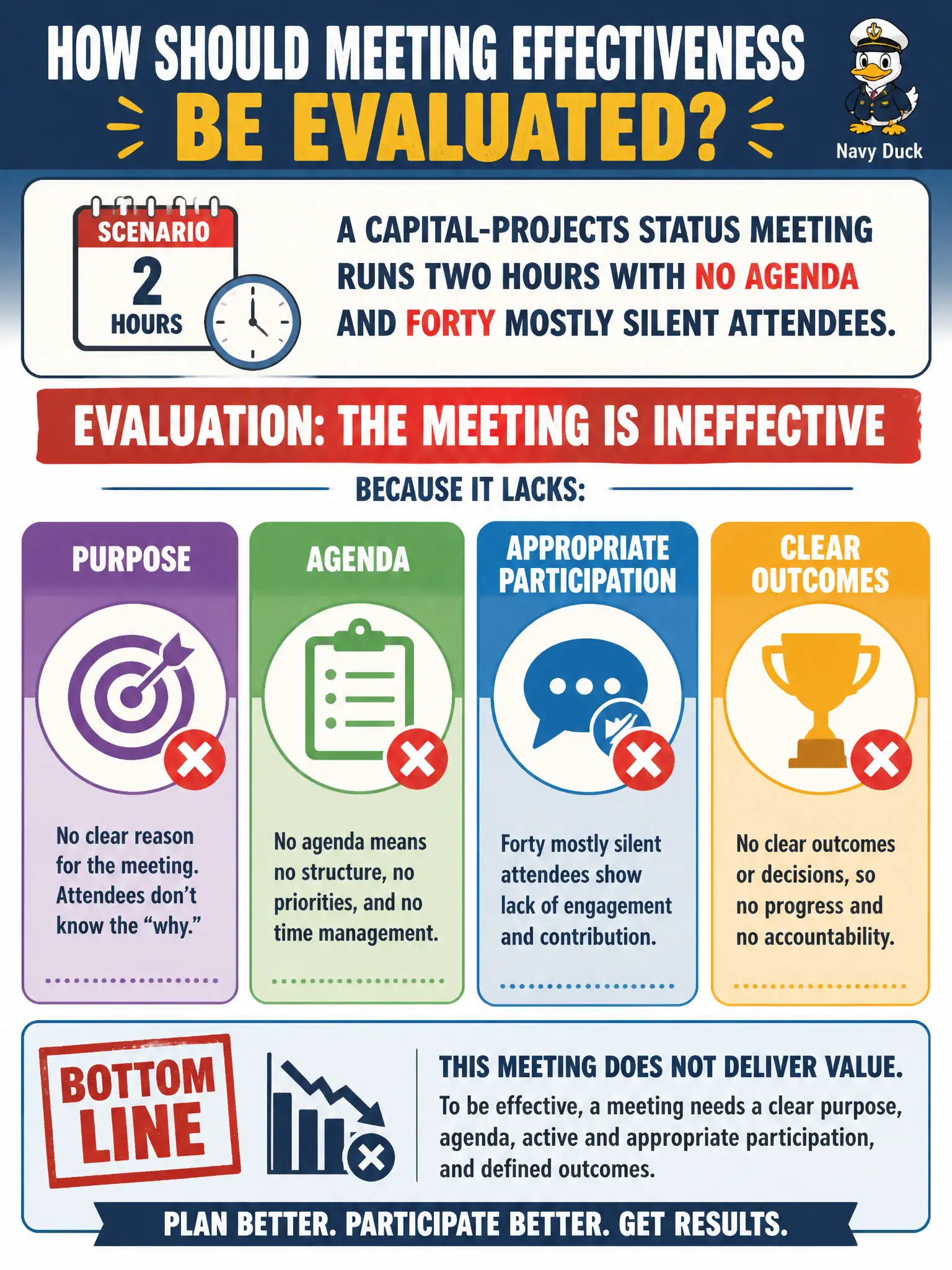
A capital-projects status meeting runs two hours with no agenda and forty mostly silent attendees. How should meeting effectiveness be evaluated?
Select an answer to reveal the explanation.
Short Explanation
A packed room with no agenda and no outcomes is a calendar tax, not a good meeting. Effective sessions have a purpose, the right people talking, and decisions or actions at the end. Headcount alone does not equal effectiveness.
Full Explanation
A capital-projects status meeting that runs two hours with no agenda and forty mostly silent attendees is ineffective because it lacks purpose, agenda, appropriate participation, and clear outcomes. Meeting effectiveness on civic programs is judged by decision quality and action clarity, not by how many people occupy chairs. Silence and duration without structure waste public staff time.
High attendance alone does not prove effectiveness; audience bloat often reduces accountability. Occupying a full calendar block is time consumption, not value. Interpreting silence as deep engagement ignores the likelihood that people are disengaged or unclear why they were invited.
Exam caveat: CAPM fundamentals include recognizing effective versus ineffective meeting patterns—purpose, right people, facilitation, and recorded outcomes. Associates should not equate visibility theater with coordination.
Operational check: cancel or restructure the meeting with a stated purpose, agenda, required decision-makers only, timebox, and a closing capture of owners and due dates; publish notes to absent stakeholders who needed visibility without attending. For capital programs, ineffective meetings also hide real blockers behind attendance theater, so sponsors receive comfort instead of decisions. Prefer fewer, sharper forums over standing invites that consume public staff capacity without changing project trajectory.