
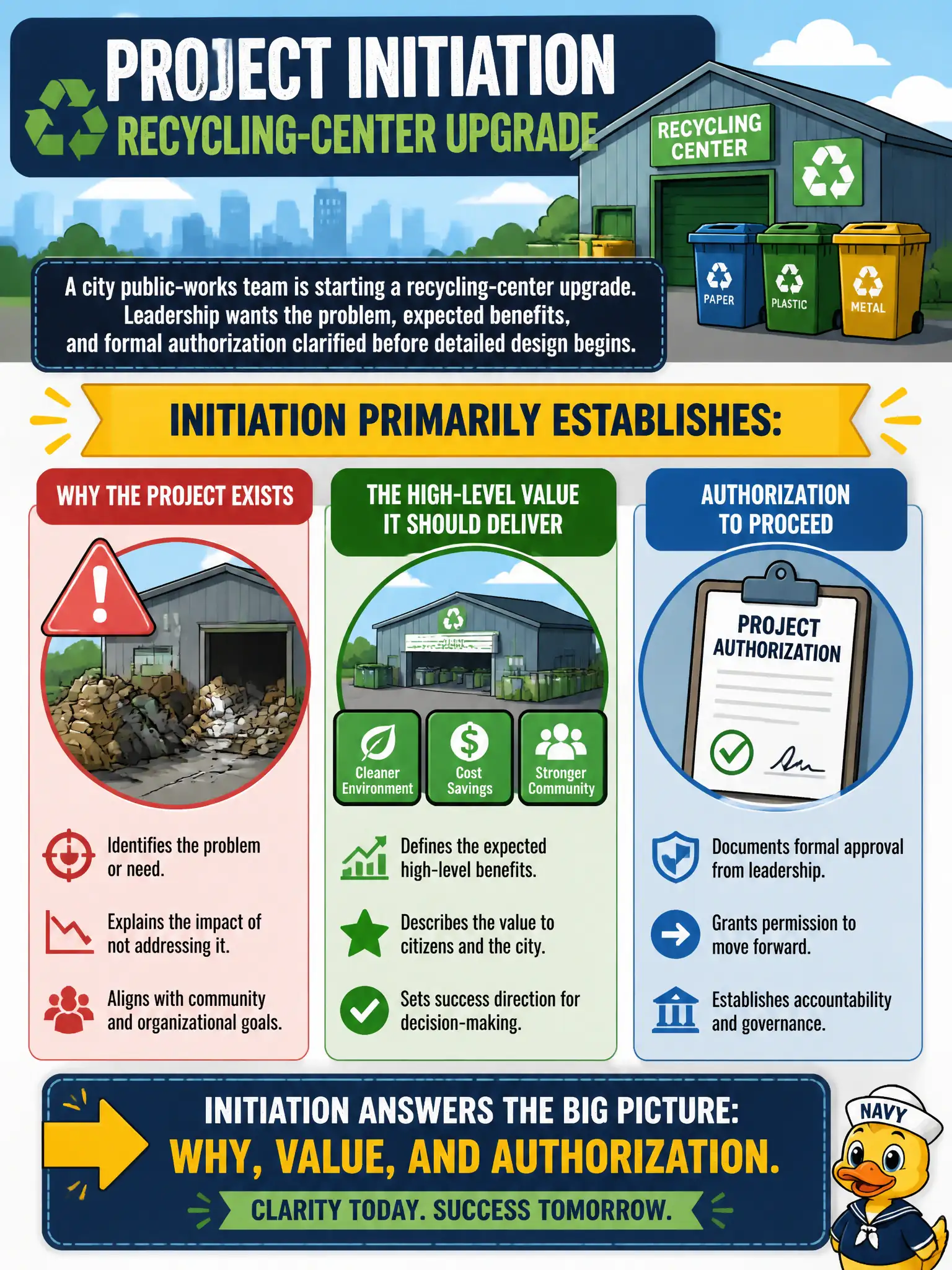
A city public-works team is starting a recycling-center upgrade. Leadership wants the problem, expected benefits, and formal authorization clarified before detailed design begins. What does initiation primarily establish?
Select an answer to reveal the explanation.
Short Explanation
Think of initiation as the green light plus the why—not the full blueprint. You lock the problem, the benefits the city cares about, and who said go. Detailed design and the WBS come after that frame is solid.
Full Explanation
Project initiation primarily establishes why a civic undertaking exists, what high-level value it should deliver, and who authorizes investment before detailed design consumes public resources. On a recycling-center upgrade, clarifying the problem statement, expected benefits, and formal authorization gives public-works leadership a controlled green light without pretending the full technical solution is already known. That framing protects the city from designing a facility that lacks sponsorship or a measurable purpose.
A complete work breakdown structure and every plant-equipment purchase order are planning and procurement products created after initiation authorizes the effort. Daily standup agendas and sprint velocity charts are execution or agile coordination tools, not initiation outputs that define problem, benefits, and authority. Final as-built drawings and operations handover checklists belong to closeout and transition to operations, far downstream of the start decision.
Exam caveat: CAPM associates should separate initiation intent from planning detail—chartering does not require a finished WBS, and a WBS does not replace authorization. Initiation answers “why and who says go,” while planning answers “how we will deliver.”
Operational check: before detailed design starts, confirm a signed or approved initiation artifact that states the business problem, high-level benefits, and sponsoring authority; then proceed into scope and design planning with that mandate intact.