
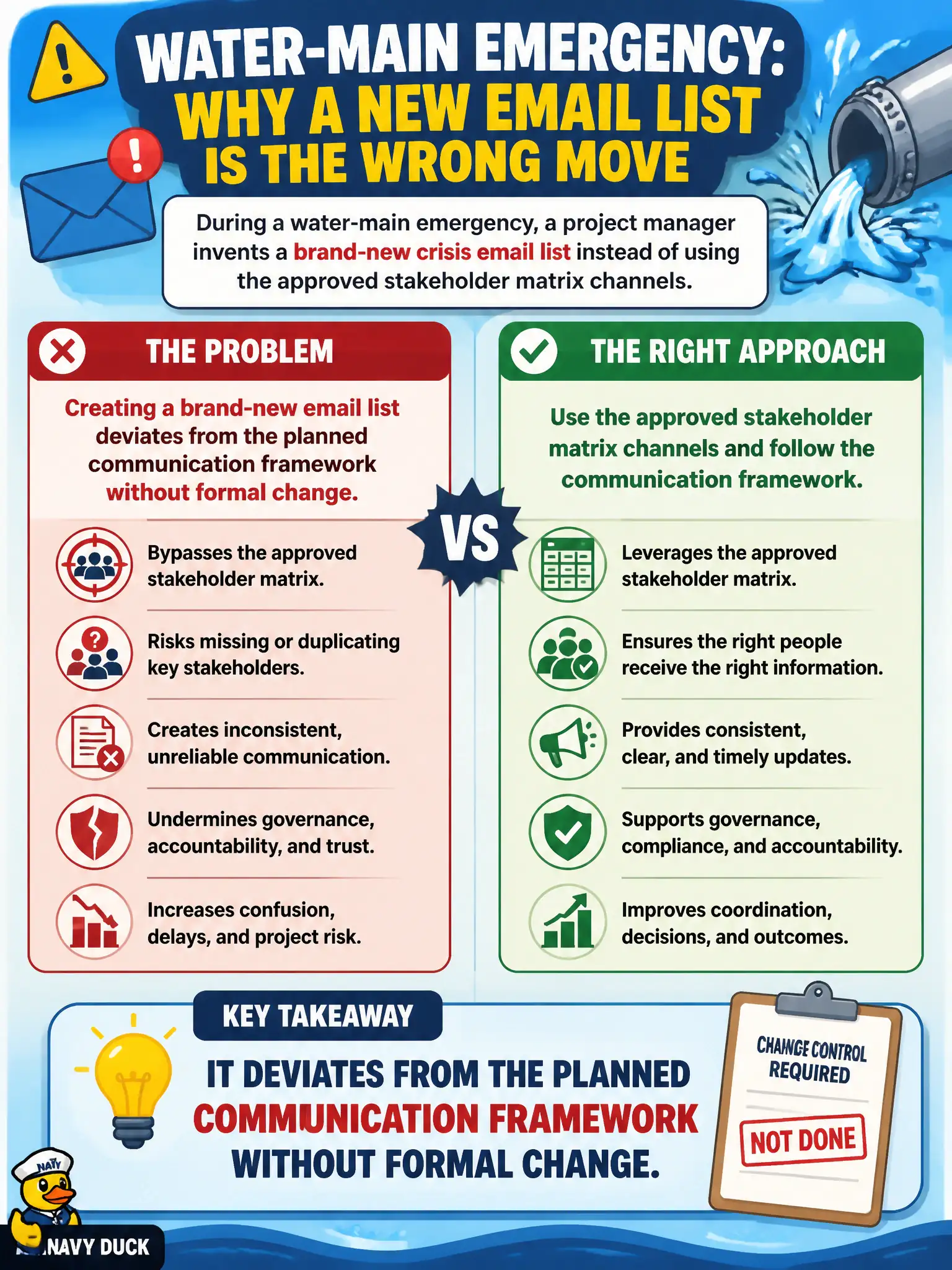
During a water-main emergency, a project manager invents a brand-new crisis email list instead of using the approved stakeholder matrix channels. Why is that approach problematic?
Select an answer to reveal the explanation.
Short Explanation
Crises tempt people to invent new mailing lists on the fly. Unless you formally change the plan, stick to the stakeholder matrix channels you already approved. Ad-hoc lists leave the right people out and the wrong people confused.
Full Explanation
Planned communication frameworks—including stakeholder matrix channels—should be followed unless formally changed. Inventing a brand-new crisis email list during a water-main emergency instead of using approved stakeholder matrix channels is problematic because it deviates from the planned framework without formal change. Saying email is forbidden on all municipal emergencies by CAPM rule fails by concept: CAPM does not ban email; it expects adherence to the agreed communication approach. Saying stakeholder matrices may never be updated even through change control fails because matrices can be updated through proper change, but inventing a parallel list without that process is the issue. Saying only the mayor may send messages when water service is disrupted fails as an absolute that is not the teaching point—the issue is unauthorized deviation from the planned channels. Exam caveat: CAPM stresses executing planned communication and risk strategies under pressure rather than ad-hoc reinvention that misses stakeholders. Operational check: use the approved stakeholder matrix distribution for emergency updates, request urgent change control if the matrix is incomplete, and reconcile any interim messages back into the official channel log.