
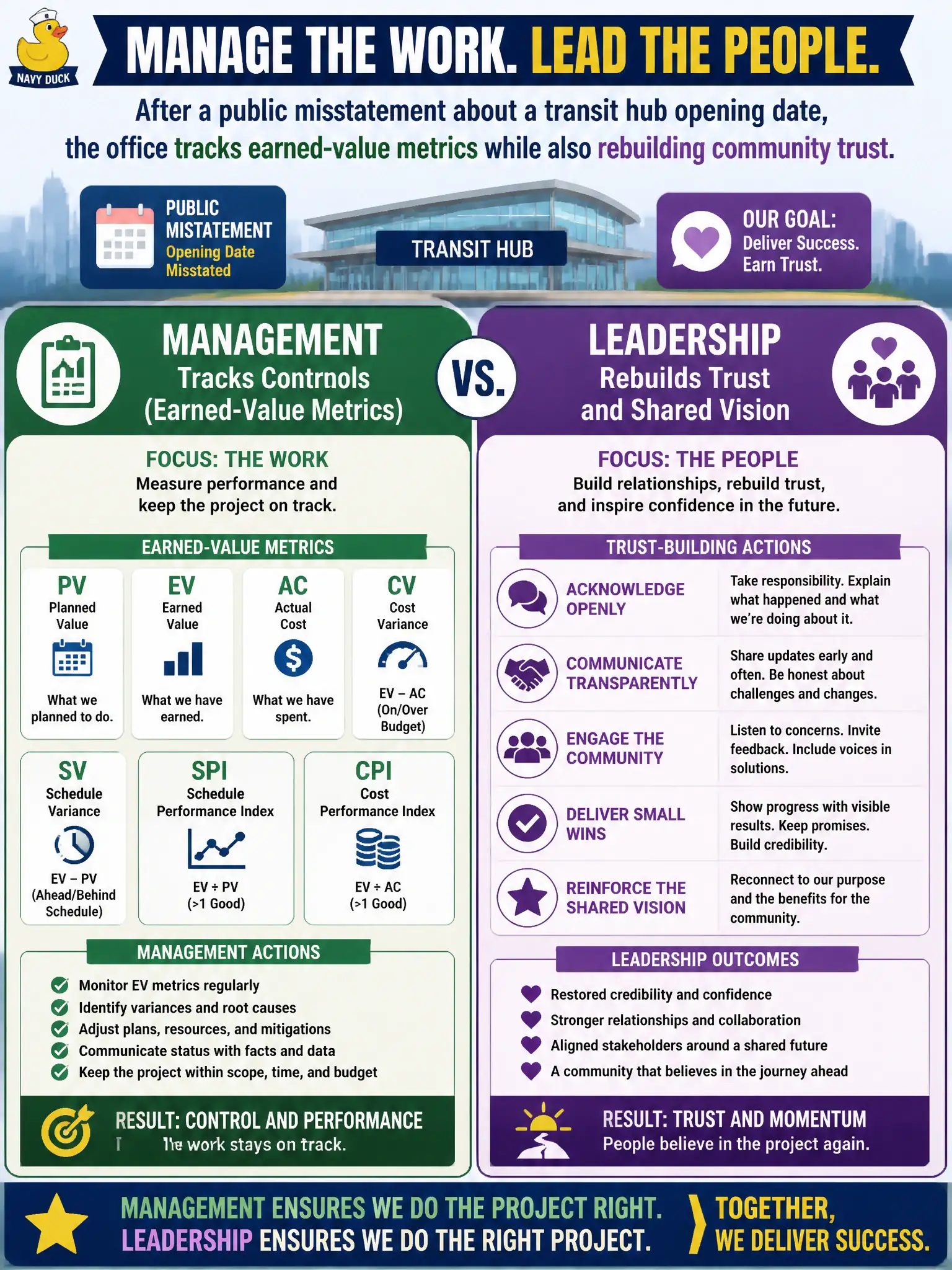
After a public misstatement about a transit hub opening date, the office tracks earned-value metrics while also rebuilding community trust. How should a candidate contrast those efforts?
Select an answer to reveal the explanation.
Short Explanation
Spreadsheets tell you where the money and schedule sit; leadership mends the public trust bruise. After a bad opening-date statement, you need both the EV numbers and the human repair work. Controls without trust—or trust without controls—leave the hub exposed.
Full Explanation
Management emphasizes measurement and control systems such as earned-value metrics, while leadership emphasizes influence, vision, and restoring trust after stakeholder damage. After a public misstatement about a transit hub opening date, tracking EV metrics while also rebuilding community trust should be contrasted that way. Saying EV tracking is leadership and rebuilding trust is only a finance task reverses the contrast between control systems and relational influence. Saying rebuilding trust replaces the need to measure cost and schedule performance fails because trust repair does not eliminate the need for performance control on a capital program. Saying neither metrics nor trust matter once a misstatement has occurred fails because both repair of relationships and continued control of delivery remain essential for civic credibility. Exam caveat: CAPM leadership-versus-management items often place soft influence beside hard controls—both are required after public communication failures. Operational check: correct the public date communication through the planned channels, run a trust-repair engagement plan, and continue EV or equivalent performance tracking so recovery is measured—not only promised.