
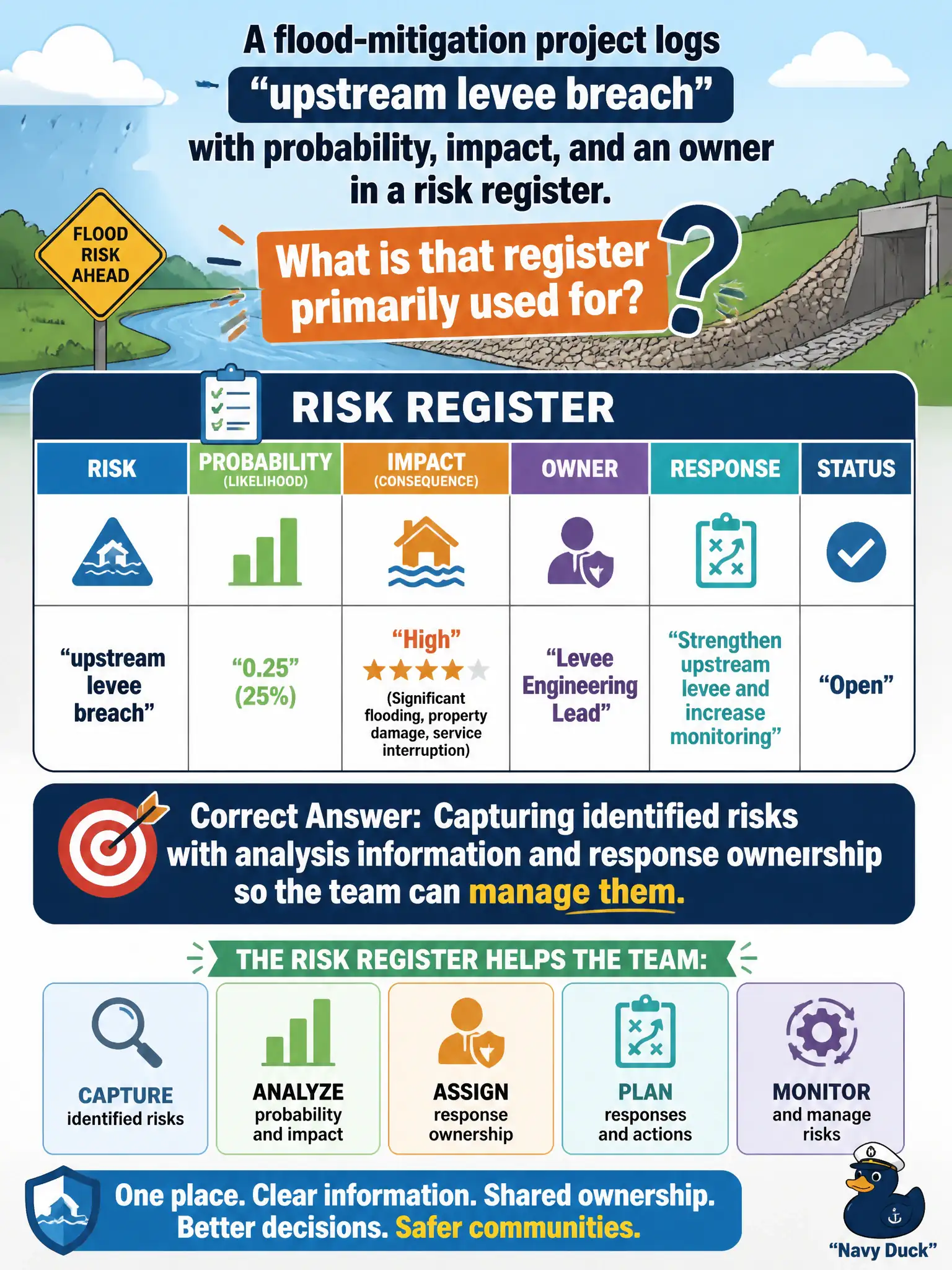
A flood-mitigation project logs 'upstream levee breach' with probability, impact, and an owner in a risk register. What is that register primarily used for?
Select an answer to reveal the explanation.
Short Explanation
The risk register is the team's shared notepad for 'what could go sideways (or right), how bad, and who owns watching it.' Levee breach sits there with odds, impact, and a name—not buried in someone's inbox.
Full Explanation
A risk register captures identified risks with analysis information and response ownership so the team can manage them throughout delivery. Logging “upstream levee breach” with probability, impact, and an owner on a flood-mitigation project is the register’s primary use. Saying the register lists only completed defects after storms for warranty claims fails by concept: that describes issue or defect tracking after realization, not proactive risk management of uncertain future events. Saying it replaces the stakeholder register by treating every resident as a risk entry fails because stakeholders and risks are different artifacts with different purposes and fields. Saying it records weather forecasts as mandatory scope that must be built into the WBS fails because forecasts may inform risk analysis; they are not automatically mandatory WBS scope elements. Exam caveat: CAPM expects the risk register to hold uncertain events with analysis and ownership—do not confuse it with issue logs, stakeholder registers, or scope lists. Operational check: keep probability, impact, owner, and response fields current for the levee-breach risk, review it in risk meetings, and link response actions to schedule contingency and flood operations procedures as needed.