
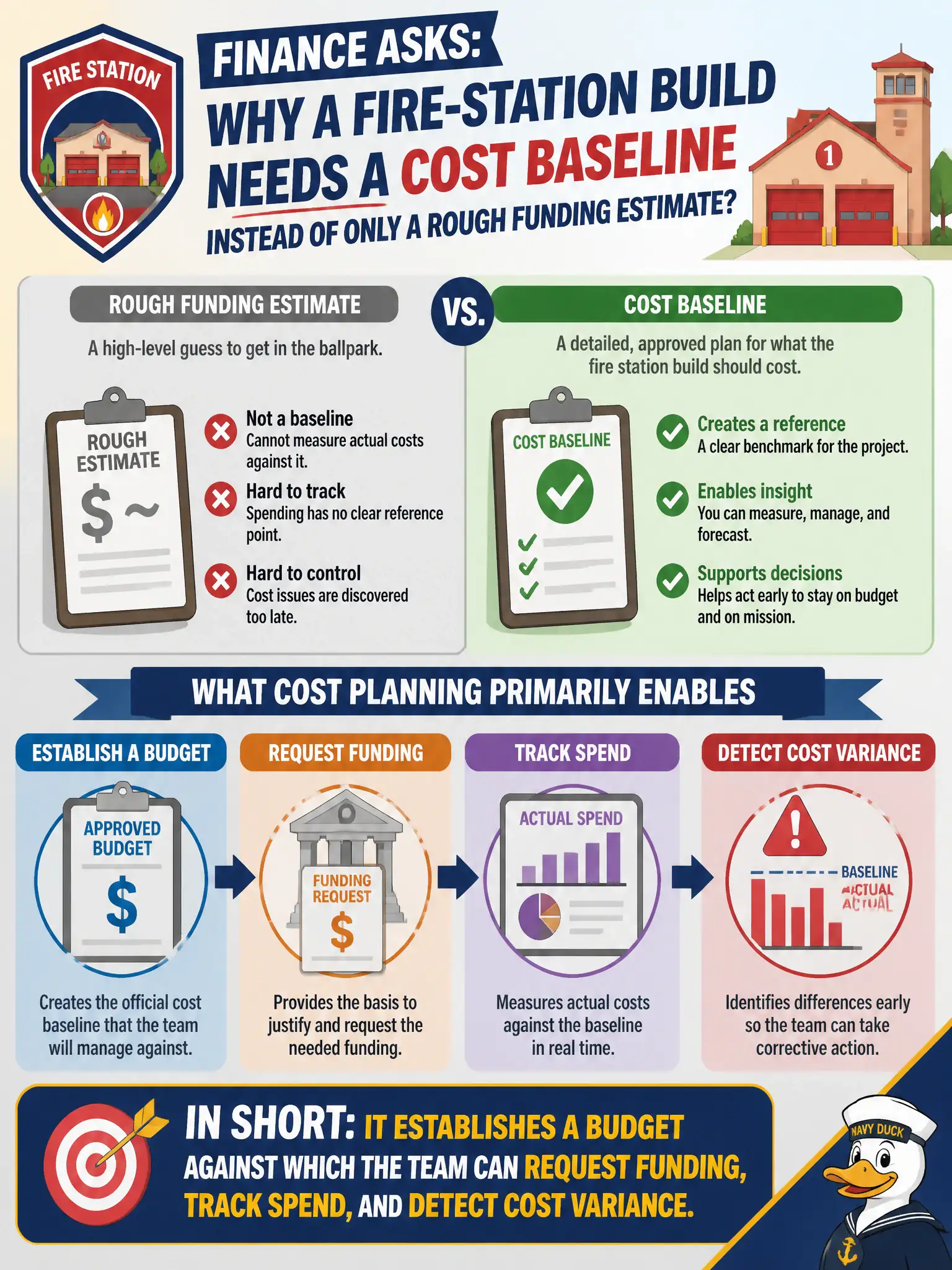
Finance asks why a fire-station build needs a cost baseline instead of only a rough funding estimate. What does cost planning primarily enable?
Select an answer to reveal the explanation.
Short Explanation
A cost baseline is the speedometer for the money: you need a planned miles-per-hour before you know if you are burning cash too fast. Rough guesses do not give finance a control line to compare against.
Full Explanation
Cost planning establishes an approved budget (cost baseline) against which the fire-station team can request funding, track spend, and detect cost variance. A rough funding estimate alone does not provide that control reference. Claiming a cost baseline guarantees that actual spending will never exceed the political appropriation fails by concept: baselines enable detection and management of variance—they do not magically prevent overruns. Claiming cost planning replaces earned value so variance reports are unnecessary fails because cost baselines are inputs to performance measurement, not substitutes that eliminate variance analysis. Claiming it converts the schedule into a quality checklist for automatic invoice approval fails because cost planning addresses money, not inspection acceptance criteria. Exam caveat: CAPM cost questions distinguish estimates (developing numbers) from baselines (approved versions used for control)—finance’s ask points to the control purpose of the baseline. Operational check: approve a cost baseline that rolls up work-package estimates, track actuals against it monthly, escalate forecast overruns early, and keep change-driven budget updates under change control.