
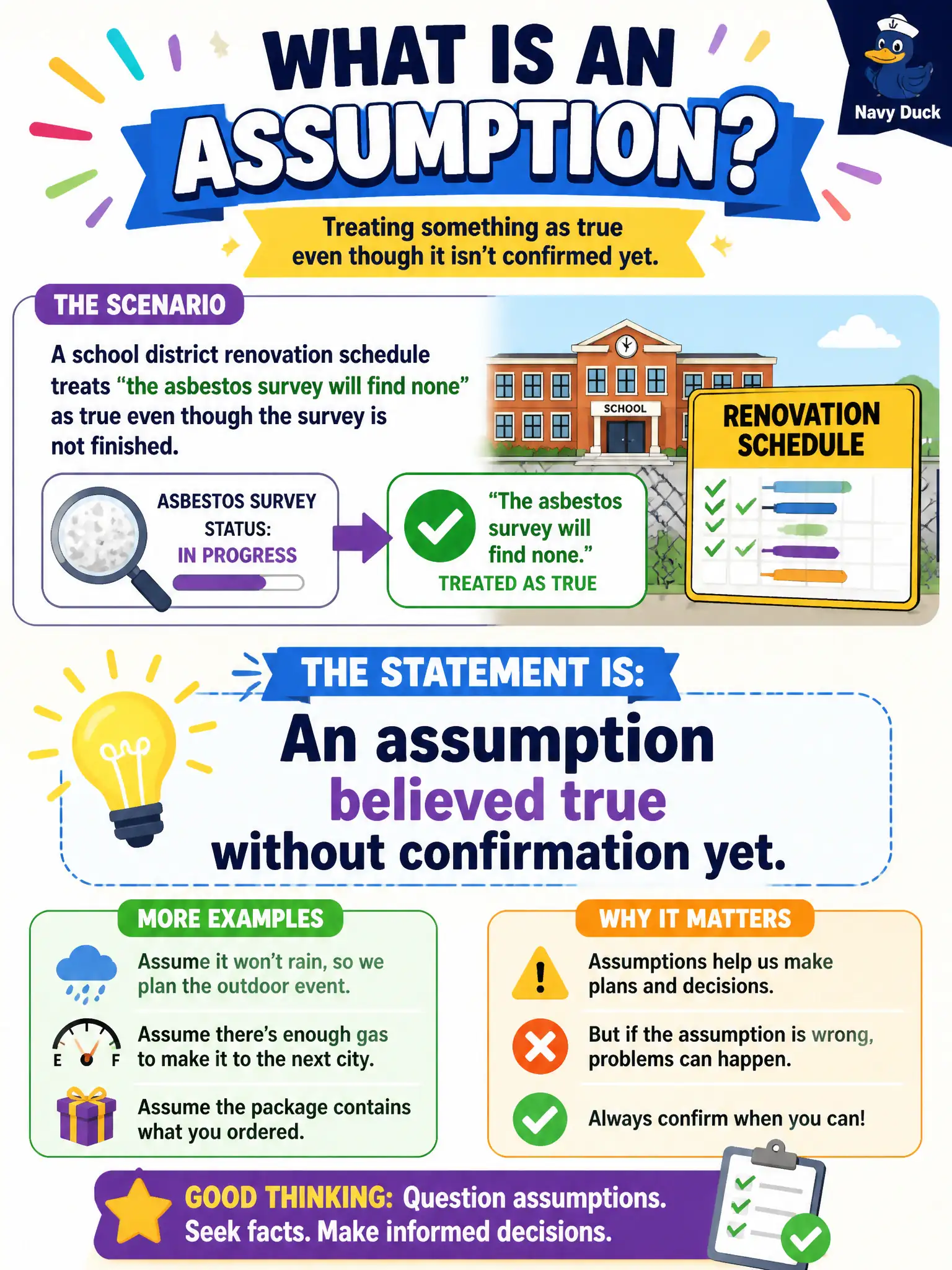
A school district renovation schedule treats “the asbestos survey will find none” as true even though the survey is not finished. What is that statement?
Select an answer to reveal the explanation.
Short Explanation
Believing “no asbestos” before the survey comes back is an assumption—useful for planning, but unproven. Assumptions need tracking so they can be tested; they are not constraints, live issues, or closed risks.
Full Explanation
An assumption is a factor considered true for planning without full verification. Treating “the asbestos survey will find none” as true while the school-district survey is unfinished is therefore an assumption that must be tracked and validated. Calling it a verified constraint that permanently freezes the demolition date fails by concept: constraints are imposed limits already in force; an unverified survey outcome is not a confirmed freeze, and labeling it verified is inaccurate. Calling it an issue already blocking inspectors on site today fails because the stem describes a planning belief, not a present blocking condition already realized on site. Calling it a closed risk with a realized strike that already happened fails because nothing has occurred yet—there is no realized asbestos find or strike event to close. Exam caveat: CAPM items mix assumption, constraint, risk, and issue; assumptions that prove false often become issues or trigger risk responses, so keep them visible until validated. Operational check: record the asbestos-free assumption in an assumption log, assign a validation owner and date tied to survey completion, and define the contingency if asbestos is found before demolition proceeds.