
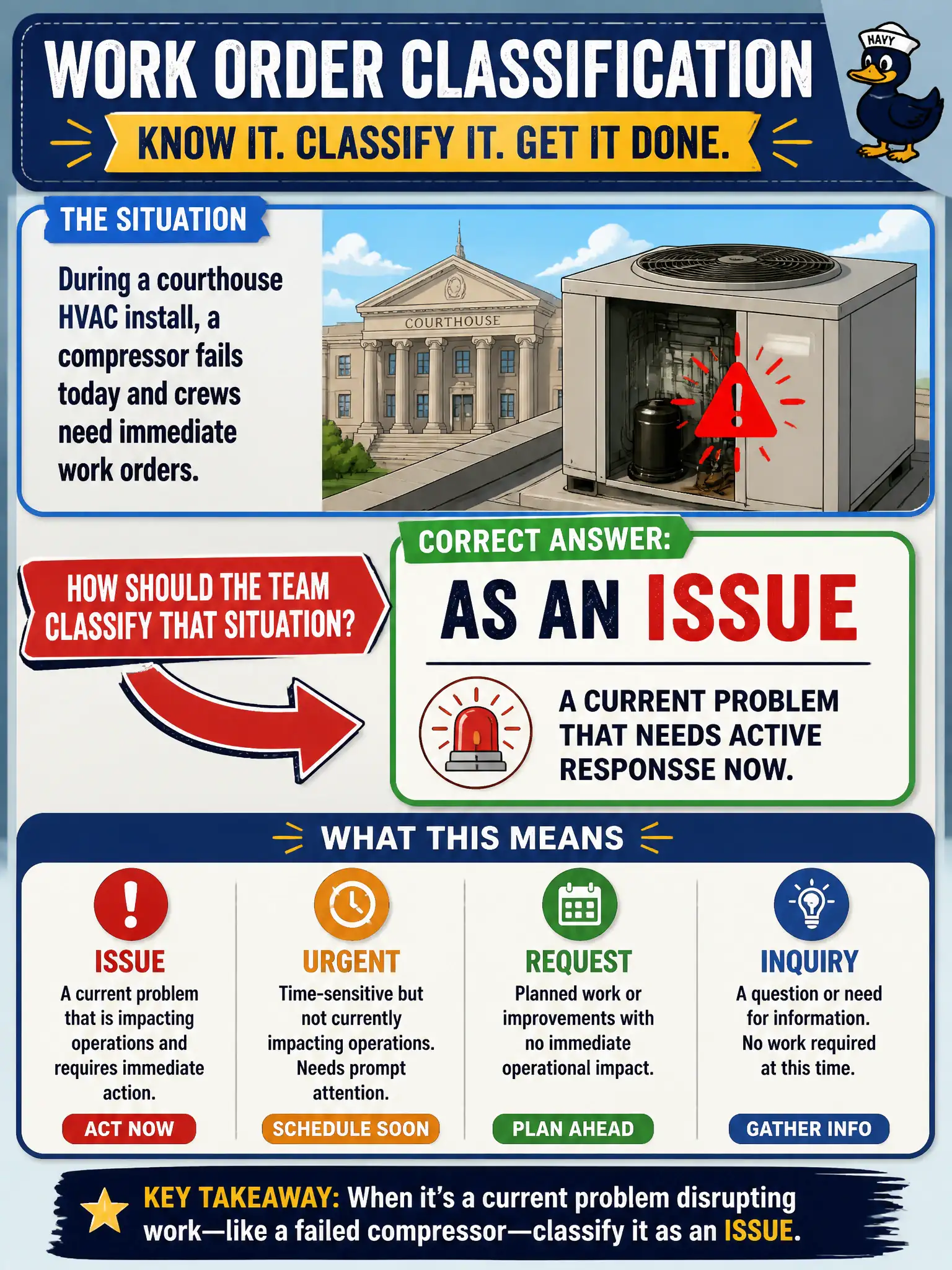
During a courthouse HVAC install, a compressor fails today and crews need immediate work orders. How should the team classify that situation?
Select an answer to reveal the explanation.
Short Explanation
If the compressor is already dead on the floor, you’re not worrying about a maybe—you’re dealing with an issue right now. Risks live in the future; issues are today’s mess that needs a work order.
Full Explanation
An issue is a present problem that requires resolution; a compressor that has already failed during a courthouse HVAC install and needs immediate work orders is an issue. Classifying it as a risk fails by concept because a risk is an uncertain future event or condition that has not yet occurred—the failure is already here. Treating it as an assumption that the compressor will somehow recover itself fails because assumptions are factors believed true for planning without proof; hoping for spontaneous recovery is not a valid planning assumption and does not manage the present defect. Calling it a constraint that permanently caps the project budget fails because constraints are imposed limits such as budget ceilings or mandated dates; equipment failure is a realized problem, not a standing limit definition. Exam caveat: CAPM and PMI terminology questions routinely swap issue and risk—ask whether the event has already materialized (issue) or remains uncertain (risk). Operational check: log the failed compressor in the issue log with owner and due date, issue the work order, update schedule impacts, and separately keep future HVAC failure modes in the risk register if residual uncertainty remains.