
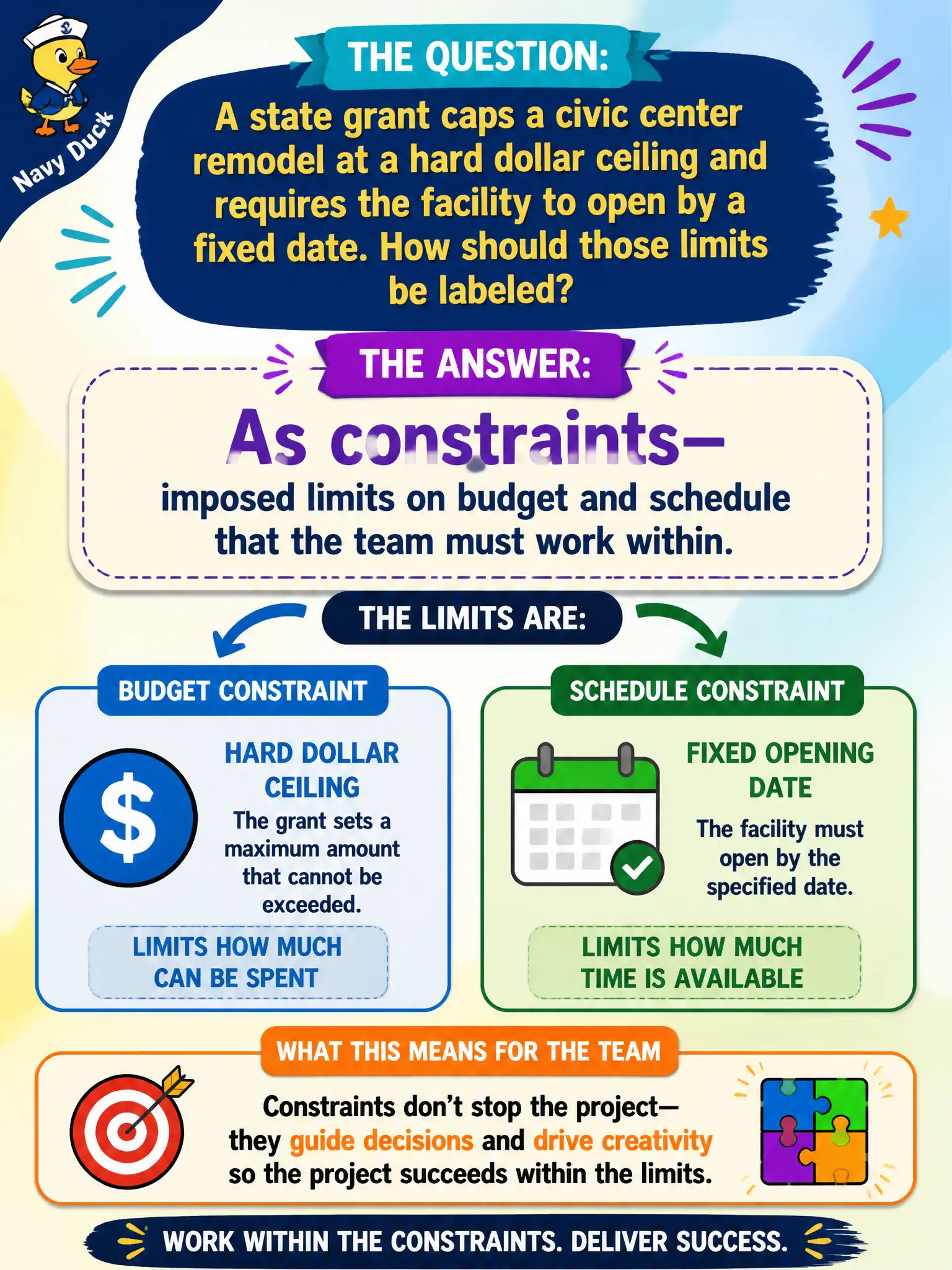
A state grant caps a civic center remodel at a hard dollar ceiling and requires the facility to open by a fixed date. How should those limits be labeled?
Select an answer to reveal the explanation.
Short Explanation
A hard dollar ceiling and a fixed open-by date are walls around the work—constraints. They are not “maybe” risks or hopeful assumptions; they are limits already written into the deal.
Full Explanation
Constraints are limiting factors already imposed on the project, such as a state grant’s hard dollar ceiling and mandatory open-by date for a civic center remodel. Those limits are constraints the team must work within. Labeling them as risks that might appear if funding or weather changes later fails by concept: the grant’s ceiling and date are already imposed, whereas risks describe uncertain future events. Labeling them as assumptions the team hopes the grant office will ignore fails because assumptions are unverified beliefs used for planning; grant ceilings are contractual limits, not hopes to disregard. Labeling them as issues already realized because the grant paperwork exists fails because paperwork establishing a limit is not itself a problem requiring corrective action—the limit is a constraint to plan against. Exam caveat: CAPM candidates often confuse constraints with risks; if the limit is already known and binding, classify it as a constraint and manage uncertainty about violating it as separate risk analysis. Operational check: capture the grant ceiling and open-by date in the project constraints list and baselines, design scope and schedule to fit them, and escalate early if forecasts show a breach rather than silently hoping for a waiver.